
It’s that time of year again
Overnight the New Year’s Honours List was published and – as usual – has been greeted with a mix of celebration and raised eyebrows at some of those receiving gongs and titles, and indeed what for.
See here for a link to the review of this year’s List penned by Adam Forrest that appears upon today upon the website of – THE INDEPENDENT
 Quite separately and previously, new prime minister Boris Johnson had shipped some incoming flak for awarding peerages to the likes of Zak Goldsmith (defeated in the recent General Election) and Nicky Morgan, who announced in October that she’d be leaving Parliament “to spend more time with her family” – apparently solely in order that they could retain their ministerial jobs (Parliamentary Under-Secretary of State for Environment and International Development and Culture Secretary respectively).
 My personal viewpoint of principle is that the entire notion of honours is decidedly suspect to start with – not that this takes anything away from my acknowledgement that occasionally one could not object to some distinguished recipients gaining some sort of recognition for their lifetime or specific achievements.
I am also opposed to to political life peerages of the type dished out by Boris, where the intent is to enable those so elevated to to remain part of the “Establishment club” – trousering ‘per diem’ and other expenses, vaguely swanning about in the corridors of power and dining in plush restaurants inside guilded palaces (under the pretext of supposedly making a contribution, difference or ‘putting something back’) without the annoying inconvenience of having to account to the voter for their performances.
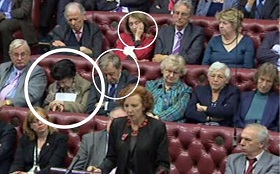 This either as a ‘sop’ because they’ve lost their seats in a General Election and/or because the government of the day needs to “re-set” the balance of power in the House of Lords by piling into it those willing to act (as directed) as unthinking cannon fodder blanket support in any Upper Chamber votes.
Which, of course, ignores the ongoing existential issue of whether, if an Second Chamber is desired at all- which may be another argument altogether – it should continue in the 21st Century as the crusty anachronism established in the 19th (if not 18th Century) that it is.
The other thing that occurred to me as I looked down Mr Forrest’s report was the extent to which the fashionable “politically-correct, ‘woke’, diversity” influence that has inevitably and increasingly crept into the List.
Honouring people on merit is one thing, but spraying gongs around in all directions – apparently primarily in order to ‘tick’ a growing range of PC boxes – and then bathing in the anticipated glow of ‘right on’ respect this produces is possibly another.
I refer readers to the penultimate paragraph of Mr Forrest’s report:
“More than half – 51 per cent – of the recipients on this year’s list are women, a slight increase on the 47 per cent in last year’s list. Some 11 per cent of recipients consider themselves to have a disability: the highest proportion for this category since numbers on disability started to be reported in 2016.“
One could view this as a simple recording of fact – or, alternatively, as a sign that these days the Establishment is deciding these things according some sort of quota imperative.
