
Calm before the storm
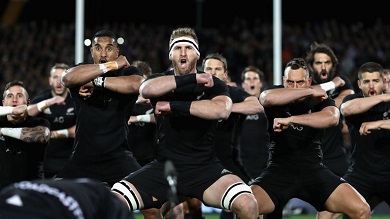
Last night I watched my recording of Beneath the Black: A Journey Through New Zealand Rugby, a Sky Sports documentary produced as part of the build-up to the opening of the British and Irish Lions tour of that country that begins tomorrow at the Toll Stadium in Whangarei (North Island) with a relatively undemanding game against the NZ Provincial Barbarians.
That may be a bit of a misnomer – for no international touring side visiting New Zealand is there a ‘relatively undemanding’ game.
With a huge caveat that, inevitably, no introductory piece about the country of the Land of Long White Cloud and its borderline unhealthy obsession with the oval ball version of football is ever going to be much less than tourist propaganda, this was nevertheless an endearing and rewarding sixty-five minutes of time spent.
 Not having visited New Zealand myself, it was fascinating to see some of its wonderful scenery and be exposed to a wide variety of its population. The first thing that struck home was the space and the general lack of people.
We’re only talking comparative figures here but New Zealand is approximately 110% the size of the United Kingdom and yet still only boasts a population of 4.5 million, of whom approximately 330,000 are of Polynesian/Pacific Islander descent, compared to our 65 million.
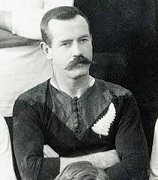
Dave Gallaher
The programme opened with former All Blacks captain Sean Fitzpatrick visiting Poperinge in Belgium to pay his respects at the WW1 gravestone of the legendary Dave Gallaher – killed at Passendaele in 1917, captain of the first-ever All Blacks tour to Europe in 1905/06.
That squad’s marauding players hit the UK with a seismic impact – in advance they had been thought of as little more than a novelty from the colonies who would be thrashed out of sight by ‘our boys’. It took only their first match in England, a 55-4 thrashing of county champions Devon at Exeter, to change that misconception.
They were a rugby equivalent of the Harlem Globetrotters, leavened with more than a touch of quiet but uncompromising demeanour. To British fans rugby was ‘the greatest of all games’, but still just a game, whilst to the Kiwis it was far more than that. As Fitzpatrick explained, for his little country on the far side of the world, the confluence of their rugby culture and the horrors of WW1 suffered by their troops (and those of their fellow Anzacs the Australians) forged a national identity that has endured ever since. Some 54 Kiwis had been capped for New Zealand by the time they entered the War and 13 (roughly a quarter) of them never came home.
The next lesson I learned was that the influx of Polynesians and Pacific Islanders began in the 1960s and 1970s, when New Zealand was desperately trying to attract labouring workers. The first Pacific Islander to make a significant mark was Bryan Williams, the wing threequarter who many in the United Kingdom will best remember for his part in the famous 1973 Barbarians match against New Zealand. He became an All Black icon and – in a country where rugby is practically all that matters – he paved the way, not only for others of Islander extraction such as the flanker Michael Jones to ascend rugby’s Mount Olympus, but for unqualified acceptance of Pacific Islanders into the national culture.
Lastly, the other notable aspect of New Zealand culture was the unassuming nature of those featured.
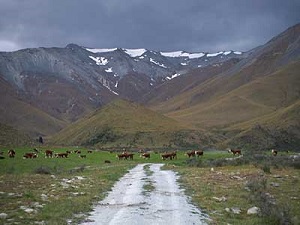 There were vignettes featuring recently-retired former All Black captain and flanker Richie McCaw and current All Black fly half Beauden Barrett.
Both came from what I might inappropriately refer to as tiny one-horse towns in the South Island, brought up working on their family farms [see left Kurow, home town of McCaw].
The programme contained interviews with former teachers and others who had known them all their lives and the mutual respect between these great players and the places from which they had originated was palpable, as if each of these All Blacks had sprung from an extended family that embraced everyone who lived there right down to the storekeepers.
And, as likely as not, once their careers were over, they’d go back to live in those communities once again.
 There are not a few things about New Zealand rugby culture that some of us around the world tend to respect rather than admire, but there’s no doubt that the Kiwis are a remarkable people as is proved by the enormous achievements their nation has enjoyed in virtually every sport known to man.
