
A sign of our times
Someone commented to me a fortnight or so ago that the Rust is losing both its edge and relevance.
“How so?” I asked.
The unabashed response that latterly it had been progressively developing into a one-eyed reactionary organ, no doubt because our contributors are uniformly ancient and increasingly consigned to wrapping themselves in their nostalgic, ill-remembered and often fantasy memories of how things were all so much easier – but also so much harder – ‘in their day’.
I’ll leave our esteemed Brains Trust – sorry, editorial board – to work out whether any of the above is true, or even a matter of concern, as today I blog once again about the vexed subjects of women’s professional soccer and the world of PC gone mad.
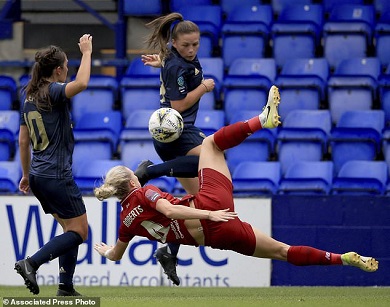
 It so happens that the night before last, on one of the obscurer sports channels available (either on Sky Sports or BT Sports) to me at home courtesy of Virgin Media, I caught up with about fifty minutes’ worth of a repeat showing of the women’s Continental League Cup clash between Manchester United and Liverpool, won 1-0 by the former.
For those uninterested and/or uneducated in the ways of female football in the UK (or should I say England?) I should here register that – after a long period in the wilderness and some intense lobbying by the PC lobby, earlier this year Manchester United announced their return to the world of female football by re-establishing a womens’ team.
 One could argue that this was a positive and progressive move. After all, the likes of top Premiership clubs such as Arsenal, Chelsea, Liverpool and Manchester City had already done this some years ago and have become leading lights in the Women’s National League – so why should not Manchester United, perhaps one of the top five football club franchises in the world, also set an example?
Clearly, gaining an automatic place at the top table just because of who they were – and let’s face it, also because at that point they didn’t even have a team squad – was (rightly in my view) regarded as a step too far, so ‘Manchester United WFC’ were admitted into the FA Women’s Championship, i.e. the ‘tier 2’ level.
 They acquired recently-retired women’s football semi-legend Casey Stoner as their head coach – since retiring from the game in 2017 she’d been assisting Phil Neville in his role as England Women’s head coach – and under her direction they went about ‘acquiring’ a female squad.
Seven of these were duly poached from Liverpool FC Women.
And so we came this week to the Manchester United v Liverpool women’s football Continental League Cup match – the Manchester United women’s first-ever game in their new incarnation.
 I have to be honest with Rust readers – the action was very much as I expected it was going to be.
The trouble with women playing what any dinosaur like me would routinely describe as a ‘man’s game’ is – to appropriate and twist inelegantly the Samuel Johnson quip about a women preaching – is that the one and only remarkable thing about the fare being presented to the public – for their entertainment but also the taking of their hard cash – is the fact that it is being played by women.
It’s certainly not the quality of the football, which I should estimate – in terms of the men’s game – is about the level of an Under-15 match.
There’s no other way of saying this: simply because of the relative size and strength of the female body, women playing football on a full-sized pitch is a pedestrianly slow and inferior spectacle.
 Let me put it another way.
The action on display in the women’s hockey World Cup recently played in East London was several times faster and more exciting than anything seen in this 1-0 Manchester United Women’s victory over Liverpool.
When bringing the ball out from defence, a women’s hockey team can pass the ball amongst its back four and then forward almost as swiftly any dynamically as a male equivalent.
 Not so a women’s football team.
At one point in the game a Manchester United central defender collected the ball from her goalkeeper and then, together with her left and right back colleagues, contrived to pass it no fewer than nine times (I counted them) back and forth amongst themselves about a third of the way up the field, without ever either seriously being challenged by an opponent and/or seeking to thump the ball to someone in midfield or further forward.
Still, at least it seems that I am not the only person who has noticed the various ‘issues’ currently besetting women’s football in England.
Here’s a link to an article by Suzanne Wrack detailing a raft of them, as appears today upon the website of – THE GUARDIAN
Obviously Ms Wrack is coming at the state of women’s soccer from a different perspective to me – she sees most of the items she lists as a series of teething problems the authorities need to address and sort out, whereas I see them as symptoms of the fundamental weakness with women’s football as a concept, i.e. the quality of the product.
As Ms Wrack highlights, despite all the hype and publicity (and the fact the game was originally shown live on television) – in other words, it was given every possible assistance regards ‘spreading the women’s football gospel’ – this aforementioned Manchester United v Liverpool women’s match attracted only 829 paying spectators and looked positively ‘lost’ even in an otherwise empty Tranmere Rovers home ground.
