
The Truth about Franco/PBS
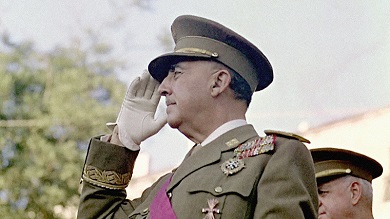
This PBS documentary on General Franco was thorough enough but you could see it was not made by Ken Burns as it was not nearly as even-handed as his work.
The two experts most used were Franco’s biographer Paul Preston, who is resolutely anti-Franco, and the distinguished writer historian Anthony Beevor.
It’s quite easy to find the faults in Franco: his ruthless rise to the top made easier by the suspicious aviation death of his superior General Moro, the commander of the northern forces; the help he received in the Civil War from Nazi Germany and fascist Italy; his grip on Spain for some 30 years after the War; the suppression of the Catalonian language and the abduction of newly-born babies.
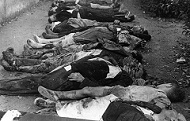 You heard less – if anything – of the atrocities committed on the Republican side, who killed 5000 priests, nor of Franco’s contribution to modern Spain – mass tourism, the Seat car, the predominance of Real Madrid in the 1950s.
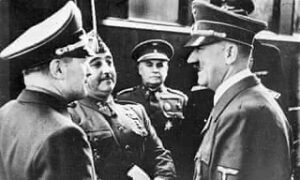 His role in the Second World War as an Axis supporter needed more careful analysis.
True, he contributed his Blue Regiment to the Nazi eastern front but he is best classified as neutral, never ceding the vital port of Cadiz to the Axis.
Spain was a country to which refugees escaped.
 Once at a book launch I asked Paul Preston about Franco and the Jews. He replied that it was too complicated a subject to be discussed here.
More likely Franco’s more favourable treatment of Jews alienated him from the Nazi eugenic theories and did not conform to the Preston prototype.
Nonetheless, over 4 parts you got a full picture of one of the longest-serving leaders Western Europe has ever known.
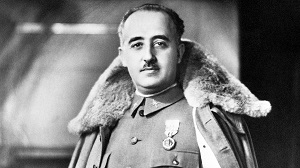 He came from a naval family in Galicia but was too short to enlist in the navy.
He joined the Army and quickly rose through the ranks in Morocco.
A failed coup resulted in him being banished to the Canaries as Governor but he was one of the leading generals in the coup of 1936 which began the Spanish Civil War.
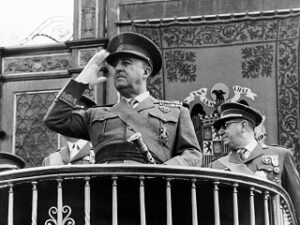 The Republican cause was fragmented between a conventional government and a rag-tag collection of idealist and idealogues, most of whom had never held a rifle in their life.
Franco’s determination won the day but he was determined to impose his rule on every square metre of Spain and did.
He was sufficiently distant from the main Axis powers to be courted as anti-communist supporter in the Cold War.
By 1959 President Dwight Eisenhower was visiting Spain.
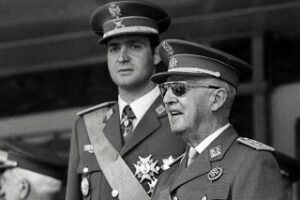 In his latter years of ill health Franco appointed King Juan Carlos as his successor but power lay with his wife and Admiral Blanco who was assassinated by ETA in 1973.
In 1975 Franco died and Juan Carlos held off an abortive coup to restore the monarchy and democracy.
I thought there may be a final part assessing the legacy of Franco and modern Spain as part of the EU but still troubled by regional independence.
There was not.
Nonetheless if you are looking for a picture of Franco this documentary – with contemporary news reel footage and interviews – is more accessible than any written biography.
