
The Flying Prince (book review)
As someone who has penned the odd item intended for public consumption myself, not just my membership of the mythical “writers’ union” makes me generally wary of offering criticism of the efforts of my fellow authors and/or scribes.
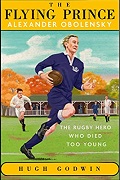 And so it is today with a degree of humility and trepidation that I offer a minor issue with Hugh Godwin’s recently published The Flying Prince – subtitled The Rugby Hero Who Died Too Young – (Hodder & Stoughton, £20, pp.290), a new biography of the pre-WW2 England rugby player Prince Alexander Obolensky.
I recently bought a copy and found it a riveting read.
 The book has been rightly praised for the depth and breadth of its research and Godwin, a sports journalist of thirty years’ standing who has majored on rugby – he’s reported on no fewer than five Rugby World Cups, was rugby correspondent of the Independent On Sunday for eight years and has occupied the same post for the i since 2016 – brings to the table his lightly-worn but deep knowledge and understanding of the sport and its culture.
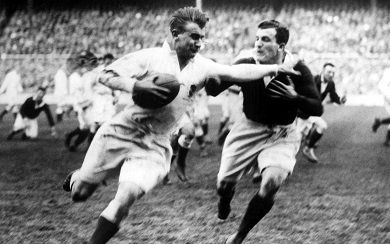
Many Rusters will no doubt be aware of the “Obo” story – the escape with his aristocratic Russian family from the tyranny of Soviet Russia, his “British” upbringing and his annus mirabilis of 1936 when, as a 19 year old Oxford University student playing on the right wing, he scored two outstanding tries in a famous England 13- 0 victory over the All Blacks at Twickenham.
See the famous British Movietone reel of them here, courtesy of – YOUTUBE
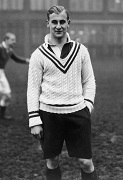 Sadly, the course of his life after this epic match was somewhat disappointing.
Despite his aristocratic background and supreme talents as a rugby player, “Obo” won only three England caps in total and was an average student academically. He was commissioned as a student pilot in the Royal Auxiliary Air Force in August 1939 and on 29th March 1940 was killed aged 24 in a “pilot error” training accident when his Hurricane overshot the runway at Martlesham Heath airfield in Suffolk.
I began this post by mentioning my reluctance to be critical of anyone who dares to take up their metaphorical pen and write anything.
My slight reservation with Mr Godwin’s book concern the occasional passages in which, in order to convey e.g. the atmosphere leading up to a big game, he conjures up as “fact” one or more little incidents for which – I suspect – in reality there exists little or no source.
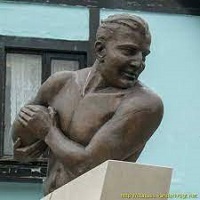 Here’s an example of what I mean:
On 4th January 1936 – the day of the famous victory over New Zealand – the England team took a special bus from central London down to Cole Court Hotel in Twickenham for a pre-match lunch.
Godwin picks up the story thus:
“Alex sat next to Hal Sever, who was doing his best not to feel jittery. Both of the England wings were about to make their international debuts. The 25 year-old Sever had spent the past fortnight fretting about tripping over the pavement or pulling a muscle.
Alex lit a cigarette and jiggled his legs to keep the muscles supple. His eyes flitted to the people on the pavements – mostly men, and almost all wearing overcoats and hats. The captain, Bernard Gagney, came down the aisle of the bus from the back seats. Later Sever recalled how he soothed their worries: ‘He talked about anything but rugby’ …”
Call me an ungracious nit-picker if you will, but the small passage about “Obo” lighting a cigarette, jiggling his legs and looking at the people on the pavements jarred with me somewhat.
One can, of course, put it down to justifiable “poetic licence” on Godwin’s part – and, to be fair, all those acts might well have been things that “Obo” (or anyone in his situation) might have done in the circumstances … but I simply ask the question “Where is the evidence that he did any of them?”
