
Eddie Jones in the dock
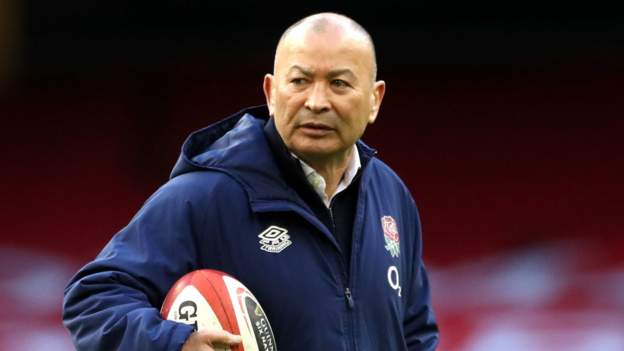
The fall-out ramifications from England’s loss to Scotland in the Calcutta Cup match on Saturday evening continue to dominate the sporting media and – justifiably, many fans and pundits believe – Eddie Jones continues to cop most of the flak for England’s spectacular slide from seemingly domination of the course of play to abject defeat in the final quarter of the game.
 Jones’ relationship with the rugby press has followed a broadly familiar and stereotypical pattern.
He took the reins as head coach in late 2015 awash with goodwill and high expectations after the relative debacle and implosion of the Stuart Lancaster regime at that year’s Rugby World Cup.
At the time his arrival seemed a bit of a coup for the RFU.
 Eddie had a track record and reputation as a world class coach; his Japanese team had famously dealt out a shock defeat to South Africa at the RWC; his workaholic nature and abrasive persona were seen as destined to bring a new approach and a breath of fresh air; and – (best of all) he was a complete antidote to the earnest but allegedly limited and uninspiring Lancaster.
To begin with everything went well.
 The new coach’s unorthodox and brutal training methods seemed to have an energising effect. Complacency, rigid set plays and conventional approaches to each and every aspect of international rugby went out the window.
Eddie – who had the advantage of always giving blunt and entertaining (“great copy”) interviews – challenged everyone and everything. England’s results improved immeasurably and Eddie played up to his reputation as an iconoclast, constantly keeping his specialist coaches and players on their toes with his 5.30am starts to the day and sometimes whacky decisions and selections.
 But then the “Jones magic dust” gradually seemed to subside – along with the consistency of England’s results. In his time he has “bloodied” over 120 players by bringing them into England training camps – and then also in the majority of cases discarded them again after giving them 5 or less caps (and in some cases none at all).
Media criticism of some of his decisions began to rear its head. Where was the consistency, the progression, the medium term plan that would take England to success in the 2019 Rugby World Cup in Japan?
Some of the sharper critics began to suggest that Jones was a rugby “emperor with no clothes” – he wasn’t a strategic thinker at all.
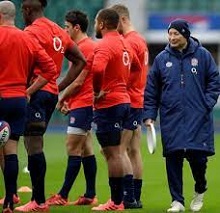 He was beginning to be viewed as a one-trick pony: yes, he could come in “throw all the balls up in the air”, change everything around and thereby reinvigorate an international squad that had grown complacent and/or stale for a while, but that was all.
And the results might improve for a period. But there was no underlying “scheme” to anything he did.
And whenever results went the wrong way, he could disarm some of the flak with his frank admissions that the opposition had played better and thoroughly deserved their win on the day – and he was going to “fix” the England time by this time next week.
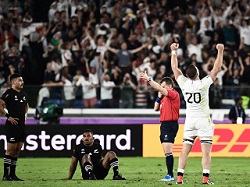 Then came the semi-final victory against New Zealand in the 2019 Rugby World Cup.
On that day England hit a purple patch and played out of their skins. Suddenly Eddie wasn’t just a maverick huckster who occasionally got lucky – he was now the real deal and we all believed that England were going to win the William Webb Ellis trophy for the first time in 16 years.
But England didn’t. In the RWC Final they were thoroughly bested in every department by a limited but very determined and inspired Springboks squad – and yes, Kyle Sinckler’s unlucky withdrawal with a bad case of concussion suffered in the opening minutes was something of a watershed, but it had little to do with the eventual result.
Many pundits had assumed that Eddie Jones had been hired for a single RWC cycle and that he would depart immediately after the 2019 RWC, both because he himself would want to move on and also because the RFU would require any new head coach to be in place in good time for the 2023 RWC.
 But that didn’t happen.
Somewhere along the line – as discussions continued and media speculation ran rife – suddenly Eddie was offered, and accepted, another World Cup cycle at England’s helm.
The result is that he’s now in an unassailable position until 2023.
Last year’s Six Nations was a massive disaster (England finished fifth out of six) and now, after Saturday’s astonishing collapse, Eddie’s stock as an international coach has become a recommended “sell” by his UK rugby scribe critics and indeed many England fans, but Eddie is going nowhere.
 The most galling aspect of Saturday’s capitulation, some might argue, is that (never mind his growing army of critics), any sports fan worth his or her salt – even those not particularly interested in rugby per se – could see the illogicality of Jones’ decision to whip fly half Marcus Smith off with twenty minutes to go and replace him with George Ford.
Whatever Eddie’s reasoning behind the switch (was it just that Ford is a “safer” controller of a game?) the aspect of the decline in England’s fortunes from that point was not Ford himself. but rather the one feature at which Jones is supposed to excel: dealing with the unexpected by “endlessly rehearsing and playing through unusual situations”, e.g. a referee’s decision to issue a yellow card and/or a sending off reducing the team to 14 or even 13.
On Saturday, after Ford came on, England had a run of “unexpecteds” and just couldn’t cope with them.
That’s where Eddie Jones has failed. The one thing he’s supposed to be good at.
