
A decidedly unimpressive outing
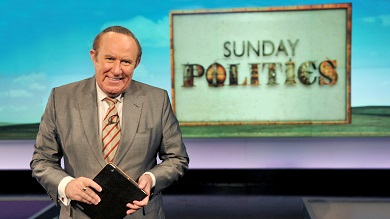
Being en route to London at the time I was unable to watch yesterday’s BBC1 Sunday Politics show as it was being transmitted (unusually) mid-afternoon due to priority being granted to the Beeb’s coverage of the London Marathon. Instead, after a little technical difficulty, I managed to locate in on my television’s BBC iPlayer facility and watched a recording of it from about 6.40pm in advance of my evening meal.
[A digression before I proceed further …]
I acknowledge that the modern fashion is to download things such as music, TV shows and movies – indeed I’ve blogged before (I cannot recall whether it was on the Rust or elsewhere) about how in the brave near future will every home will boast either a huge domestic screen, or indeed just a designated wall, onto which everything we currently watch on TV and/or our computer will be projected and, rather than paying subscriptions for hundreds of channels we never use, we shall just ‘pay per view’ any item we have decided to watch any time of day we have chosen to watch it … unless of course it is a ‘live’ broadcast.
However, and if this is a contradictory and/or generational thing then I’m happy to plead guilty, I shall never understand the ‘pull’ of watching the whole of a television series via a service like Netflix, BBC iPlayer or similar in advance of it being broadcast for the first time. For the past five weeks my weekly television watching has been scheduled around not just the 9.00pm Sunday night showing on BBC1 of Series 4 of Jed Mercurio’s Line of Duty but the gradual anticipatory build-up of each passing day as it takes me another 24 hours closer to seeing the next episode.
The news that, if I had wanted, I could have gone to BBC iPlayer about three weeks ago, downloaded all six episodes and watch them at one sitting if I’d so chosen, thereby becoming three if not four weeks ahead of those who don’t or can’t use BBC iPlayer, means nothing at all to me. I can’t see the point. Half the joy of watching the blessed thing at 9.00pm on a Sunday night is the knowledge that I’m one of a substantial ‘live’ audience that is collectively viewing it for the first simultaneously.]
Back to today’s post:
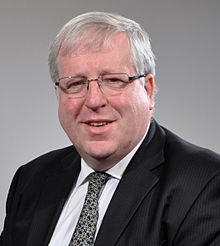 Yesterday one of Andrew Neil’s set-piece studio interviews was with Sir Patrick McLoughlin.
Wikipedia’s entry on said gentleman reveals him to be 59 years old, a Derbyshire MP of twenty-nine years’ vintage, currently representing the Derbyshire Dales constituency, who was appointed by Theresa May as Chairman of the Conservative Party and Chancellor of the Duchy of Lancaster in July 2016.
From a Tory Party strategy point of view – and we veteran political observers have now slipped into ‘jaded hack’ mode (a defensive move adopted to ensure mental survival over the next seven weeks) whereby we assume that every Westminster politician’s uttering on TV and radio is part of a deliberate roll-out of election strategy orchestrated in every detail by Head Office – and/or the latest style guru hired to assist each of the main parties prevail on 8th June – yesterday Mr McLoughlin was clearly the ‘next taxi cab off the rank’ to go out and face Britain’s national media.
I had been first exposed to him yesterday being interviewed on the John Pienaar Show on Radio Five Live at about 10.30am. My theory would be that his appearance on the Sunday Politics show did not go out ‘live’ at 3.15pm but had been recorded during a ‘one size fits all’ session at BBC Broadcasting House in London during which he spent all morning trotting out the Party line to a succession of media outlets.
As it happens, and this doesn’t happen often, there is a telling two-sentence passage within Mr McLoughlin’s Wikipedia entry, under Personal Life:
‘McLoughlin has been married to Lyn Newman since 1984. The couple have one son and one daughter. McLoughlin kept a low profile before becoming Transport Secretary and would rarely give interviews.’
Now – for all I know Mrs McLoughlin may regard Mr McLoughlin as an all-time sex god, comedic genius and charismatic party animal. Indeed I hope she does.
And before achieving ministerial status as Transport Secretary in 2012 he may have been one of those modest and even shy individuals who prefers to keep a low profile and beaver away at the coal face. Not all Indians can be chiefs and good luck to him.
However, based upon the evidence of his appearances on radio and television yesterday, I would hazard a guess that, somewhere within the Tory HQ, someone very important had made a judgement a good while back that Mr McLoughlin’s file card should be marked with ‘A plodder – to be used only as a last resort‘ when it came to putting across Party policy or positions.
Nevertheless, yesterday, out there he was.
On both the John Pienaar Show and Sunday Politics I have rarely heard anyone perform with such lacklustre sheen. Totally devoid of charisma or affable human social empathy, he burbled out stock political stone-walling phrases and lines by the paragraph whilst also trying to adopt the tone and style of a heavyweight politician.
The resulting impact on the viewers – well, certainly this one – was entirely negative.
It was if the Sunday Politics was a classic BBC comedy sketch show from days gone by when someone like Steve Coogan, Rowan Atkinson, Griff Rhys Jones or even Ronnie Barker is pretending to be a pompous mediocre Westminster politician who only speaks in clichés and blathers on interminably without actually saying anything at all.
My considered reaction was that the Tories must be in seriously dire straits if Mr McLoughlin is genuinely the best man to hold any office, let alone that of their Party Chairman, given that he could easily bore for Britain’s national team in the ‘Boring Politicians European Championships’.
If I had been John Pienaar or Andrew Neil yesterday, I’d have been sorely tempted to stop my interviews with him after two questions and move on to another item, but not before telling Mr McLoughlin that – as he’s clearly intending to disrespect and patronise both his interviewer and audience by not answering a single question but just filling up the airtime with meaningless hot air – on behalf of its viewers and in the national interest, the BBC reserves the right to cut proceedings short.
I suppose the only irony is that, if the BBC did have such a policy, very few political interviews would last more than two minutes.
