
A memorable lunch
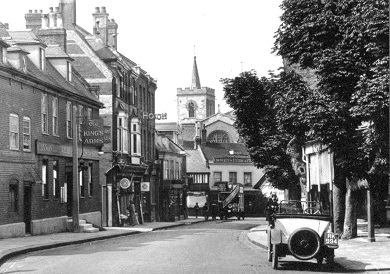
Yesterday my brother and I took our father for a visit to where he and his parents used to live in south London between about 1932 and 1939, this before going on for lunch with one of his oldest remaining pals, with whom he had been a prep school before the start of WW2.
As is the nature of life and time, both leading participants at lunch were both somewhat more decrepit that when I last saw them together at a similar function about nine months ago. Their first exchange upon meeting yesterday was an agreement that “growing old is not to be recommended”.
My father’s mobility is now sufficiently limited and slow that he needs the support of someone at his elbow to get about happily and without concerns as to where he is going and whether he is going to over-balance whilst getting there. Buster (eighteen months his senior) was also reduced. Still hale and hearty at the table and in conversation, he had just had some dental work done and by his own admission was now much less steady on his feet than hitherto, constantly fearful that he was going to take a tumble.
To some amusement all round (and raised eyebrows on the part of my brother and myself) our first topic of conversation was that of paedophilic schoolmasters – the prompt for this being the revelations of a serious pupil abuse scandal by masters at St Paul’s School and its connected prep school Colet Court between the 1970s and 1990s that had been plastered all over the broadsheet newspapers in recent times.
Both nonagenarians named the headmaster of their well-known alma mater as a raging abuser of small boys and discussed his activities. It was also clear that he was not the only master there at the time of a similar disposition.
Buster told of how, some time after WW2, the headmaster was brought to justice – or what passed for it in those days. A boy revealed all to his parents. A meeting of parents and other in authority was convened, the headmaster summoned and a ‘take it or leave it’ deal put to him. Although he owned the school, he was to put its ownership into a trust, ‘disappear’ and never work with young children again. In return, he would not be reported to the police. And that is exactly what happened.
By chance, said headmaster was also an outstanding cricket coach. At one stage he worked with a boy who turned into one of England’s finest post-WW2 batsmen and recommended that, for his public school education, he should be sent on to Uppingham. However, the lad’s father ignored this advice and sent him to another famous public school. Subsequently Buster came to know said batsman – and many other leading cricketers – very well indeed. The batsman told Buster that for the rest of his life the aforementioned headmaster not only never spoke to him but actually turned his back whenever their paths crossed at leading cricket grounds, apparently all because his advice about schooling had been ignored.
In summary we had an excellent meal and a lively conversation yesterday, most of it flowing from Buster, a classic clubbable man with a twinkle in his eye and a huge interest in everything that life can offer.
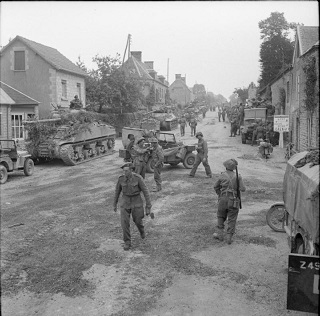 During WW2, as a 19-year old gunner subaltern, he had taken part in the Normandy Landings on Gold Beach, arriving four days after the D-Day itself (6th June 1944). He described how last year he and his two sons had done a tour of the areas of Normandy in which he had fought (his sons visiting said places for the first time), including a failed attempt to take a particular village south-east of Caen some six weeks or so after D-Day, which he described as “the most vicious battle I ever took part in”.
The unit he was attached to was ordered to advance down into a valley and then up a hill towards the village which was occupied by German troops. As the artillery officer he volunteered to go with them but instead was ordered to stay where he was and observe (this was an artillery officer’s main duty during an advance, in case artillery fire needed to be brought to bear). This he did by sight and by keeping in touch with the advance by radio.
Eventually his commanding officer in the rear called him on the radio and told him the advance had failed. He was to wait for the retreating three units to pass back behind him and then fire a barrage towards the village before retreating himself. He waited. Eventually a badly wounded Argyll & Sutherland Highlander staggered by, and a little later a group of eight or nine men. He kept waiting for a further period until his commanding officer came on the radio again, asking why the hell he hadn’t yet put up his barrage. He replied that less than a dozen men had so far come by him. He was then told that they were all that remained of the several hundred men that had set off down the valley. The rest had been completely wiped out.
He therefore ordered his men to fire a barrage at the village and then retired as ordered.
He later asked a survivor about the fate of the senior officer of the attacking party, with whom he had earlier pleaded to be allowed to join in the advance, and was told his head had been taken off by a shell as the battle began.
Buster’s descriptions of the details of his wartime actions were matter-of-fact, direct and in no way vainglorious. It was not the first time that I had been in the presence of someone who had ‘had a good War’ and whose zest for life had evidently remained pronounced, vital and undimmed many decades afterwards.
It brought me back to an appreciation that – if you happen to be placed in the thick of war as a young man and thereby have had to deal with matters of life and death on a daily basis, including the expectation that you and your close comrades might be killed at any moment – if you should manage to survive it all and make it to peace-time (relatively) undamaged, your perceptions about what is and is not important in life are heightened in a manner that those of anyone without a similar experience can never be.
Apart from a slight sense of disbelief at the randomness of it all – how on earth did you ‘come through’ when so many of those around you did not? – how can anything else that the rest of your life can throw at you seem more than a minor issue in comparison?
I guess this comes under the general heading ‘Valuable Lessons for Life’, especially at times when things are perhaps not going quite as one might wish. Mind you, of course, that doesn’t mean I’d ever have wished to spend time in the military in order to learn it!
