
A review of a book that took three years to read

Since the beginning of December – with some unexpected spare time on my hands – I have turned to a pastime that frankly I do far too little of … reading.
 Quite without justification because, of course, “if you want something done, give it to a busy person” – or, in this context perhaps, more appropriately, “you can always find time to do something if you want to do it badly enough” – my life has been characterised by a lack of reading simply because events seem to conspire that I am permanently “on the go” and don’t have the time.
Take yesterday – in which I first drove for two hours, had breakfast, took someone to a hospital appointment (staying 90 minutes until they were ready to come away again), had lunch, attended to email correspondence and then, shortly before 4.00pm, retired to bed for a much-needed “catch up” nap.
 From that I was rudely awoken after only about 20 minutes by an urgent phone call requiring that I immediately go to my email account, download a legal agreement – sign it where indicated – and then rush on foot to send it from my local post office by registered post … all before the establishment closed at 5.30pm, so that some important business could be concluded on Monday.
 Cue me protesting to anyone who would listen that – even at my advanced age – it was impossible even to relax and have forty winks without then immediately being interrupted by someone else and being ordered to leap into action!
However, that’s all by the by.
My purpose today is to review a book that I have been reading in my spare time recently.
 Leonardo Da Vinci – The Biography by Walter Isaacson (Simon & Schuster, hardback, 2017, £30), consists of 531 pages – not counting notes, bibliography and index.
I had bought it the moment it was published in the UK but hitherto had only dipped into, largely because it was clearly a serious work and required bouts of intense uninterrupted concentration which, for me, have been in short supply over the past three years!
Nobody will need an introduction to Leonardo so I will not provide one here.
Suffice it to say that he has been one of my heroes since I first heard of his name and achievements – it is no exaggeration to suggest that modern scholars will still be discovering new things about him, his work, theories and findings long into the 21st Century, if not beyond.
 And he never had access to Wikipedia, the internet, learned television documentaries or even the films of Charlie Chaplin.
Nevertheless, I can report that this month I have read 400 pages of Mr Isaacson’s highly-impressive tome and thereby been greatly reinforced in my naive belief born in childhood that (1) Leonardo is one of the greatest human beings that ever drew breath and (2) I could not possibly have emulated his achievements, even had I applied myself diligently from the age of six and not (as I in fact did) spent far too many of my waking hours down the pub.
All I wish to do today is to share with Rusters my joy and admiration for a drawing by Leonardo executed in coloured chalk on vellum, of which hitherto I has failed properly to appreciate the full majesty.
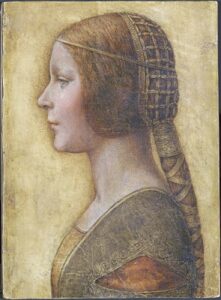 La Bella Principessa (also known as Portrait of A Young Fiancée) is thought to have been produced at some point in the 1490s, when the master was in his late thirties to early forties.
Provenance issues being what they are, it was not finally accepted as being the work of Leonardo until a fingerprint was discovered on it in 2009 which was then compared with one known to have been left by him on his work Saint Jerome In The Wilderness and pronounced to be so similar as to make no difference.
Bought by Peter Silverman, a collector with a hunch, for US$21,850 in 2008, following its subsequent authentication it was valued at US$150 million.
When I reached the plate of it in the book on page 249, I was first taken aback and then transfixed. Having then read the story of its “rediscovery”, I returned to it again and again and became utterly absorbed in its delicate and technical quality.
Isaacson draws his readers’ attention to the cord in the sitter’s hair which makes a slight indentation in the shape of the hair at the back of the head – a touch which (modern experts have said) at the time nobody but Leonardo would have noticed and included.
Behold and enjoy …
