
An issue that sport ignores at its peril
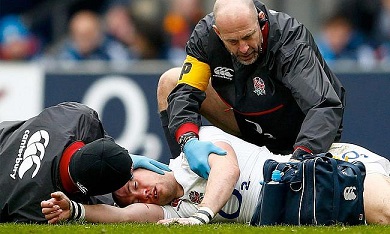
At one point during our dinner party earlier this week my better half and his mates raised the topic of the current state of rugby union – a subject in which I have a not inconsiderable interest – and it didn’t make for comfortable listening.
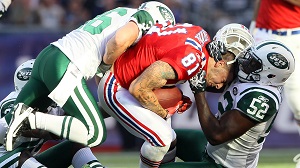 Someone mentioned the situation in the world of American NFL football in which, several years ago – having reviewed the medical advice and indeed assessed the likely financial impact of the numerous actions being made in respect of still playing or now retired players – the major clubs apparently set aside a joint figure of US$1 billion to deal with compensation claims.
To me, this figure (whilst a nice round one) sounded improbably large but – then again – in the United States most things seem to be.
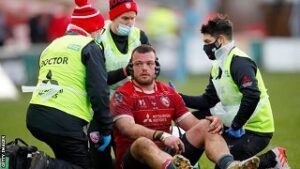 Then, of course, in the UK there are claims being advanced by a long list of former players (I’m not sure whether they’re actually formally acting together in a class action or whether it is just that they and their supporters are conducting a ‘group’ campaign) that includes several household names in rugby-following circles (England’s Steve Thompson and Wales’s Alix Popham to name but two).
In medical circles, for quite a while now, former IRB medical adviser Dr Barry O’Driscoll has been leading the movement to highlight the scale of the “head injury” crisis potentially facing both codes of the sport of rugby.
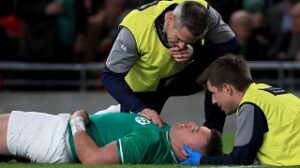 Only three weeks ago a English Premiership protocol was launched recommending limiting physical contact in training for rugby union players to just 15 minutes. This undoubtedly makes sense not least because, according to statistics I read (but cannot remember where) recently over 80% of rugby injuries are picked up on the training paddock, where these days it has become the norm for super-large and super-fit players to be prepared to receive or give out high-energy physical impacts over relatively short periods.
Long gone are the days of yore when two sides of 15 players duked it out over 80 minutes and – if anyone was injured badly enough that they couldn’t continue – it was then a case of their team being “one man down” for the remainder of the match.
In the modern game – the prime example being the infamous Springbok front five substitute bench group nick-named the “Bomb Squad” that did much to win South Africa the 2019 Rugby World Cup – coaches pick one bunch of players to work themselves to death for between 30 and 60 minutes … and then a completely different set to come on and play the remainder of the match.
 The concept that a modern front row might physically cope with playing the full 80 minutes of a rugby union match – or even the notion that they should have to in order that (echoing the classic comment of the Duke of Wellington as the Battle of Waterloo began with a sizeable and highly destructive artillery exchange: “Hard pounding, gentlemen … and let us see who will pound the longest …”) the ability of one side to outlast the other in terms of stamina and fitness should be a welcome and justifiable factor in deciding the outcome – is fanciful.
Elite rugby union games these days are practically two games in one – in fact, to simply matters for all concerned, the law-makers of the game might as well introduce a rule that both teams have to replace all fifteen starters at half time.
It has become that absurd.
 All hot air aside, rugby union has a series of huge problems to sort out – some of them potentially existential.
From funding point of view, for both elite clubs & franchises and international teams around the world, the answer to everything is to play more games and thereby to seek to attract more TV money.
This when, from a player welfare point of view, the move that would improve things immeasurably is to play fewer games (perhaps a few as half the number they currently do), not more!
That chicken is surely going to come home to roost sooner or later.
At the end of the day there’s no getting around the fact that “life is a terminal disease” and that we all have to go sometime. And yet increasingly the sporting world seems to be asking itself whether participants should be protected from themselves in terms of the potentially life-changing or life-limiting effects they routinely face in clearly hazardous pastimes, some of which have been part of human activity virtually since time immemorial.
 My last thought today, springing from the general concern in sports medicine circles around the world, is that “concussion” and dementia (early-onset or otherwise) are going to be a growing and hugely important problem for all sports, is that (and this is nothing to do with “wokeness”) arguably all physical contact sports are dangerous enough to be potential life-changing.
In that context, those such as boxing and mixed martial arts may one day face the prospect of being banned for being de facto hazardous to good health.
Both codes of rugby could also face that threat.
I write this today having read reports in the media that the retiring chairman of Professional European Club Rugby, former England international Simon Halliday, has given an interview in which he admits that his wife will not allow his sons to play rugby.
