
Comparing drama with reality
As someone who very rarely watches films these days – either in cinemas or at home via television, DVDs and downloads – I’m a little wary of venturing tentatively onto the territory patrolled by the Rust’s great Neil Rosen.
Nevertheless, I trust that the powers-that-be will allow me a little leeway today, especially since even as I began writing this piece I’m experiencing a semi-‘senior moment’ in the sense that I’m not convinced that I haven’t mentioned this true story before.
Somewhere around the turn of the century I attended some anniversary dinner or another at the Naval and Military Club, styled as being a private members’ club for officers and gentlemen of the British Armed Forces, in St James’s Square. The club is widely known as ‘The In and Out’ because at its original premises at 94 Piccadilly the entrance was a drive-in walled affair with the helpful words (for motorists and others) ‘In’ and ‘Out’ prominent on the respective entrance and exit.
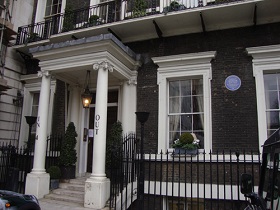 When I say ‘widely-known’, I mean that you could jump into a taxi cab anywhere from Stratford to Brentford and ask for ‘the In and Out’ and you’d be taken straight there. The tradition (or conceit) continues to this day, even after the club bought 4, St James’s Square in 1996 and moved into it in 1999 – the entrance is now up a flight of steps past two pillars, the left of which has ‘In’ painted on it and the right ‘Out’.
Anyway, quaint historical trivia knowledge context over, let me proceed to the meat of my tale.
Pardon my dementia but I cannot now recall exactly what the anniversary this official luncheon was celebrating. I’ve looked up the Club’s website which confirms it was founded in 1862, so it’s just possible that the occasion was the 140th anniversary of that event, but I’m clutching at straws here. I know it was at least the year 1998 and possibly twelve or eighteen months later than that for reasons that will soon become apparent.
As I recall it, at the meal in question I was sitting at a table for 10 with my father and at least one brother with our seven companions around the table previously unknown to us.
To my left was sitting a distinguished-looking gentleman perhaps twenty years older than myself with whom, soon after grace was said and the business of the meal began, I fell into conversation (as you do). He identified himself, after having had a career in the military, as currently the chairman or equivalent of some ambulance authority – it could have been either the London Ambulance Brigade or the St John’s Ambulance equivalent but I wouldn’t necessarily wish you to quote me on that.
Time passed and at some point midway through the meal my new pal happened to mention that one day soon he was hoping to see the 1998 Stephen Spielberg movie Saving Private Ryan (starring Tom Hanks) – dear reader, this is why I was moved to mentioned above that the occasion must have taken place in 1998 or perhaps up to eighteen months later.
As it happened, at some point (several months … a year or more?) previously I had been to the cinema to see the much-publicised Saving Private Ryan. I had been very impressed, albeit not with the bulk of the action – which from this distance I now recall as being pretty much a hackneyed tale of the US Army trying to hunt down the whereabouts of several brothers from the same family in the chaotic aftermath of the D-Day Normandy Landings in June 1944 in furtherance of a quaint US military custom that no family should have to endure the pain of more than two of its sons dying in the same military conflict.
[If memory serves, I believe that the movie was based upon a true story in which one mother had lost two or three sons killed and the last of her brood was ‘somewhere out there’ on active service and a special unit was sent to go and haul him out].
However, what had been the stand-out aspect of the movie – certainly I had thought so – was what I shall now describe as ‘the first twenty minutes’, but may have been a few minutes less or more than that.
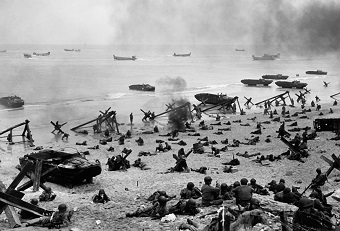 Essentially, it was a set piece tour de force cinematic representation of the first minutes of the US military’s landing on Omaha Beach during the D-Day landings on 6th June 1944.
Most will be aware that this Allied assault was one of the bloodiest and most intense actions not only of WW2 but in the whole history of modern military conflict. In total, approximately 160,000 Allied troops crossed the Channel and some 10,000 of them became casualties (4,414 confirmed dead) that fateful day.
I have heard or read that, as a deliberate policy, the US Army chiefs chose not to use their veteran marine units in the initial assault on Omaha Beach for psychological reasons. As most of their vets had already taken part in the carnage of previous Mediterranean beach landings against well-prepared and heavily dug in defences, it was felt that – being all too aware of what awaited them – they might be a bit ‘nervous’, i.e. rather than 110% fired up for the ordeal. Instead, the story goes, the US brass hats chose some of their most-recently recruited and ill-trained units (characterised by some as ‘mostly 18 year old farm boys keen to get involved in the War’) to lead the initial assault … specifically because they would have little or no idea as to what they’d be facing.
Back to my dinner.
Having the advantage of my new pal in that I had actually seen Saving Private Ryan, when he raised the subject I therefore launched into a paragraph or two about it.
The gist of my speech was that, while I wasn’t going to spoil it for him since he was planning to go to it, I could say that the opening was a bit of an ordeal for the onlooker – because of its subject matter. Then, having described broadly the set-up, I mentioned I had heard that several people who had actually taken part in the D-Day landings had testified that Spielberg’s version was sufficiently realistic that, for any modern audience member, the experience render them “almost as if they had been there”.
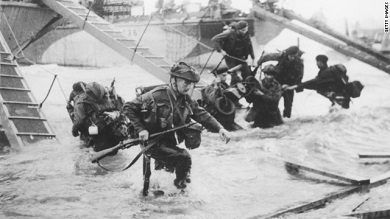
My companion thanked me heartily for my testimonial and said it had reinforced his intention to go and see the movie. It was only then in passing he revealed that, as a young junior officer, he had himself taken part in the British D-Day landing on Gold Beach …
Which brings me to this piece by Phil Hoad which appears today on the website of The Guardian and numbers the opening of Saving Private Ryan among its choices – BEST MOVIE BATTLE SCENES EVER
