
Defence: what’s it really for, exactly?
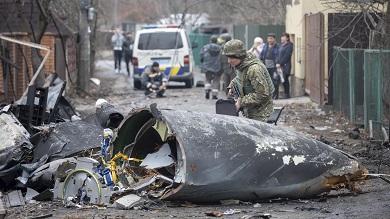
It seems to me that more than anything – never mind the current Russian invasion of the Ukraine, let’s go back and reference its seizing of the Crimean Peninsular in 2014 in furtherance of President Putin’s loony attitude to Euro-Russian geo-politics and power-balancing – the vexing subject of military might and/or international defensive alliances [cue here a mention of NATO] currently sits squarely “front and centre” in the multi-faceted glorious panoply of surreal cack-handed thinking by the varied disparate elements of the human race that from time to time come to prominence.
 For most of the world, “defence of the realm” is the supposed first and foremost duty and obligation of any national government.
At the same time – during any period of relative peace – for most governments the maintenance, servicing and “keeping up to date” of its military forces is a difficult subject for many reasons.
Why and how?
Well, let’s begin with the statement that one would like to assume no sane or rational person ever positively wants to go to war.
 That is why, when the social and domestic problems and concerns of the bulk of any population are always innumerable and complex, spending at all (never mind greatly increased spending, as military leaders will always demand) on defence and military capabilities is about as welcome as a spare do-dah at a wedding.
And thus, in most First World western countries, those in charge of the military and those in charge of conducting government and controlling national finances tend to be locked in perennial argument.
Furthermore, traditionally in Britain, for example, the Ministry of Defence’s general record of procurement blunders is never-ending and one of the biggest financial scandals of all time.
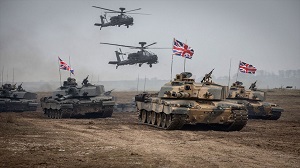 I’m referring not just to the unhappy, well-worn, ever-growing list of cock-ups – e.g. aircraft carriers for which there are no suitable aeroplanes; tanks and military people-carriers that are so slow/hot/filled with noxious fumes and/or just inherently unsuitable for certain terrains that they are positively dangerous to be inside anywhere foreign for more than a couple of hours a day at a time; the wrong kind of Army boots; classes of Navy vessels for which there are less than ten in existence and only (at best) one ever at sea because of ongoing servicing and/or repair problems, to name but a selection – but also to the fact that historically the best that any set of UK military planners can ever seem to come up with is a plan to fight “the last war that Britain was involved in” (whatever that was) slightly better … rather than to be prepared to fight the next war coming down the line, or indeed the one after that.
Here I return to a point made earlier. Nobody ever wants to actually go to war – or indeed to commit to spending the amounts it would take to fight a war in the future.
Simply by refusing to increase military spending successive Governments had effectively been conducting a “cutting back” policy.
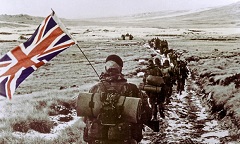 Military people I know who were involved tell me that, when the Falklands War blew up, it was only by sheer chance that Britain had the military capacity to mount the “reclamation” mission that it did. At the time for years the Tory Government had been involved in a military spending “cutting back” regime that made the entire expedition literally a “touch and go” gamble that – in the end – we just about got away with.
And then there are the existential arguments.
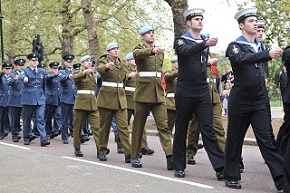
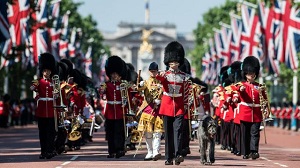 If you’re never going to go to war – because e.g. you don’t have the capability, or (if you do have it) you’re too scared to use it because of the all-round potential unpleasant consequences – then why don’t you just admit that … and then confine yourself to retaining enough military personnel and hardware to perform ceremonial duties whenever a suitable head of state is visiting the UK.
Think about the potential benefits.
When the Russian invasion force arrives at Folkestone and commences its advance towards London, the Household Cavalry could be deployed as additional traffic policemen to welcome them and wave them through up the Mall to the inevitable banquet reception at Buckingham Palace.
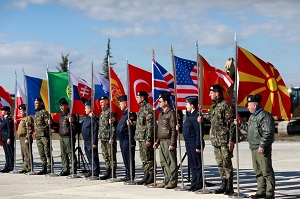 This morning I’m left wondering just what the purpose of organisations such as NATO is exactly.
As far as I can tell, the most important thing that the Russian invasion of the Ukraine has demonstrated with bells on is that First World western countries – from the USA through Britain, Australasia and the EU downwards – effectively have no intention of ever going to war if they can possibly avoid it.
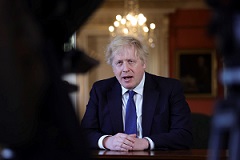 For me, Tuesday 1st February 2022 was the day – unlikely as it may seem – that Boris Johnson managed to secure his fitting place in history.
If anyone ever wanted proof of the importance (sorry, impotence) of words, our Prime Minister supplied it with his classic line that Britain would impose the severest of economic sanctions …
“… the moment the first Russian toecap enters the Ukraine”.
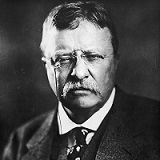 Rusters may recall that it was on 2nd September 1901, in describing his approach to foreign diplomacy, that US President Theodore Roosevelt uttered his own famous phrase
“Speak softly and carry a big stick”.
He very nearly got it right, but not quite. He should have added the words “… and be prepared to use it”.
Arguably, in 2022 the First World western countries have brought humiliation upon themselves by “Shouting hysterically and carrying a small stick” … and not even being prepared to use that.