
European Rugby Champions Cup results
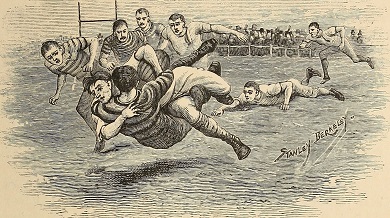
There exists a small but committed group of columnists on this organ who would admit variously to past, current or even relatively recent adherence to the fortunes of Premiership rugby club Harlequins FC.
 [For the purists or ‘anoraks’ amongst our readers interested in such things, until the 1920s it was accepted practice to refer to clubs playing both the association and rugby codes of football as “football clubs” and indeed, whilst some clubs specialised in one or the other, some clubs played both. Gradually it became the norm for rugby clubs, especially newly-formed ones, to adopt the nomenclature “Rugby Football Club (or “RFC”). Harlequins, originally called “Hampstead FC”, were founded in 1866 and soon afterwards split in two – one section going off to form Wasps and the other – wishing to retain the “HFC” (shortened) “initialled” version of their name displayed upon their logo for no other reason than it would save them money – sought out a new name beginning with “H” … eventually alighted upon an image of the (originally French/Italian) theatrical clown known as the Harlequin and decided to adopt it.
Hence Harlequins FC – the name that the club retains to this day (note that it eschews “RFC” as a nod, if not a conceit, to its 19th Century heritage).]
 Whilst on the subject of names and history generally, some Rusters unfamiliar with the details of rugby’s history might like to know that in 1895 various northern clubs (essentially in Yorkshire and Lancashire) broke and formed the “Northern Union” (professional) version of the game – this after much controversy over the subject of the game’s much-treasured amateur status being severely challenged by the very real hardship being suffered by working class players being required to take time off work to play games which had resulted in unofficial “broken time” payments that were being made in some quarters to compensate them.
[The Northern Union version of the game became officially known as “Rugby League” from 1922.]
My above diversion into rugby’s historic by-waters now brings to my subject du jour – the first of the two-leg Montpelier versus Harlequins European Champions Cup clash which I watched upon BT Sport yesterday (kick-off 1300 hours UK time).
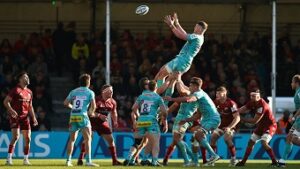 It so happened that, accompanied by My Better Half, on Saturday evening I had been making a social call visit to see an elderly gentleman in a nearby hamlet and – by happy chance – his sitting room television was tuned to live coverage of the Exeter Chiefs versus Munster match in the same competition and – chatting away – we stayed there long enough to watch the entirety of its first half.
This was a spectacle of modern rugby at its best, featuring frenetic action, a wide variety of passing both long and pop/offloads, well-organised defences, technically excellent tackling, a mix of contested and uncontested breakdowns and no quarter given or asked.
 Scotland captain Stuart Hogg – now a West Country folk hero after his stirring multi-season commitment to the Exeter cause – stood out. Everything he did dripped with purpose and intent and – six minutes in – his sudden appearance on the right wing as his team made its first breach of the Munster midfield to latch onto Tom O’Flaherty’s flat pass and switch on the after-burners to out-sprint the desperate covering defence and score in the far corner was worth the admission money on its own (er … that is, if I’d paid it which, of course, I hadn’t because I was watching proceedings on the television).
I learned later that Hogg, man of the match, had also contributed a thunderous 45 metre drop goal to the Chief’s well-deserved 13-8 victory. It’s a lead – but perhaps not a big enough one to inspire over-confidence for next weekend because no opposition can ever count their chickens facing a visit to Munster’s fortress Thomond Park.
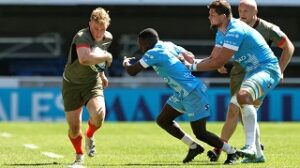 And so to the Montpelier/Harlequins clash yesterday.
A fact of 2022 life is that there are no “push-overs” in the French Top 14 league. Every team has its share of formidable monster Southern Hemisphere, often Pacific Islander, forwards and blisteringly quick outside mercenaries.
 At some point in the autumn of 2020 the Bath and two-cap England Number 8 Zach Mercer, who’ll be 25 in June, received a direct or indirect message from Eddie Jones that he didn’t figure in the Australian’s plans for the 2023 Rugby World Cup because (at 6 feet 3 and 17 and a half stone he was “too small”), so he announced in January 2021 that at the end of the season he was off to play in France with Montpelier, partly for the novelty of the experience and presumably partly to maximise his earnings in what can so often be a shortish career.
He’s since become a local talisman and apparently tops all the telling stats for back row forwards in the 2021/2022 Top 14.
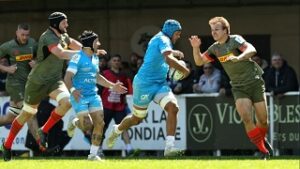 In one sense Mercer had already proved his point to those in the England set-up that matter, but yesterday lunchtime his dynamic and telling contributions to Montpelier pack’s efforts everywhere but at the set-piece (scrum time) were outstanding.
His tackling and work at the breakdown were first rate. His speed off the mark, elusiveness and “reading of the game on the hoof” were outstanding.
 To be frank, although Quins’ occasional captain Alex Dombrandt has made a highly-positive start to his England career and promises much to come, he was completely eclipsed by Mercer in the south of France sunshine who, aside from everything else he did, scored two outstanding tries and won the “Player of the Match” award.
I’m happy to admit I was one of those thrilled to pieces by the Harlequins’ extraordinary performances towards the end of the 2020/2021 season, not least their repeated ability to “come from behind” and snatch victory from the jaws of defeat.
 There will be those claiming today that Quins did enough in yesterday’s second stanza to give themselves a fighting chance in next weekend’s return leg at the Stoop.
I’m not one of them. For me, in the first half – though they threw the kitchen sink at Montpelier and never lack for effort – Quins were completely “schooled” by the home side, as the 34-0 score line at one stage demonstrated. Things tilted the way of Quins somewhat after the break but by then the blur of Montpelier substitutions had reduced the intensity of the game.
My money – though I’m not a betting woman – is on another Montpelier win next weekend – and an early exit from the competition for Quins – but I harbour a sneaking feeling that current Premiership leaders Leicester Tigers are going to go all the way to the final.
