
If I hadn’t seen it with my own eyes …
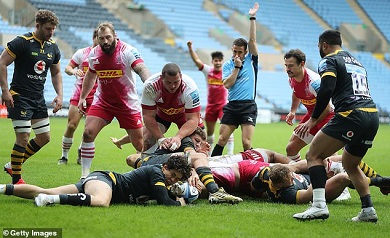
Yesterday out of the blue – simply because it was there – I opted to watch yesterday’s Premiership rugby match between Wasps and the Harlequins at the Ricoh Arena in Coventry which was being broadcast ‘live’ by BT Sport.
 Wasps and Quins have a long ‘London derby’ rivalry that began in 1867 when the membership of Hampstead FC, founded the previous year, split in two – essentially because it had become apparent that the membership’s geographical spread was unfeasibly wide.
The background to this development is worth mentioning.
In the mid-19th Century players of both what became “Association Football” (the round ball game) and “rugby” – the handling version – regarded themselves as footballers.
 This is why Hampstead, a “handling” club, called itself “Hampstead FC”.
When the aforementioned split happened, one set of Hampstead members went off and formed Wasps FC whilst the other, retaining the shell of the original club, also decided to change its name. For simplicity’s sake they chose to keep the club’s “HFC” logo and so restricted themselves to a new name beginning with “H”: hence, eventually “Harlequins FC”.
Readers may be aware that today most rugby clubs have “RFC” [Rugby Football Club] after their name. It is a quaint quirk of history that Harlequins is one of the few that retains the original “FC” part of its moniker – I mention this in case this fact should ever become useful at a pub sporting trivia quiz night!
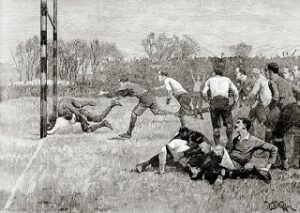 While I am on the subject, I might as well record here that, as the inevitable need for codification approached, the different versions of football went their separate ways.
The Football Association, originally purporting to represent both codes of the game, first met as an entity on 26th October 1863 at the Freemason’s Tavern in Great Queen Street, London.
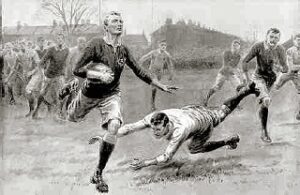 The preferences and interests of the two codes soon became irreconcilable and as a result 21 “handling” clubs split away, meeting on 26th January 1871 to form the “Rugby Union” at the Pall Mall restaurant on Regent Street.
As it happens, the first-ever international rugby match took place in Edinburgh on 27th March 1871 (a 1-0 victory to Scotland), a final score than is explained by the fact that, under the rules of the time, all the scoring of a try gave the team who managed it was an opportunity to take a place kick for a goal.
[I note in passing, of course, that 2021 marks the 150th anniversary of the first ever international game of rugby].
 The intense historic rivalry between Wasps and Harlequins has in recent times lost some of its London-centric “spice” due to the vicissitudes and stormy financial seas of professional sport and English rugby in particular.
Wasps traditionally hailed from Sudbury in Middlesex, but when professional rugby came along in 1995/1996 (after changing their name to “London Wasps”) they first moved to join up with football club Queens Park Rangers at Loftus Road; thence to the Wycombe Wanderers’ ground Adams Park; and, most recently in 2014, to the Ricoh Arena in Coventry, which they now own whilst also dropping “London” from their name and reverting to their original “Wasps” name.
However, back to my subject de jour.
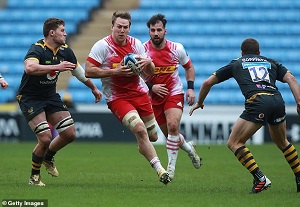 Yesterday’s game – one of the most entertaining and extraordinary I have witnessed in a decade – ended, quite against all the expectations of commentators, pundits and fans of both clubs, with a Wasps home defeat by a score of 17-49.
As a former fanatical Quins supporter it gives me no particular pleasure to record that over the past six seasons the playing fortunes of Quins – I have no longer have knowledge of the state of the club off the pitch, but the way it was going (in my experience as an increasingly disillusioned minor “insider” in the two seasons before I walked away) it seemed to be on a one-way descent to total mediocrity – have dipped alarmingly.
Hitherto during this new Covid-19 affected season Quins had found themselves somewhat fortunate to be occupying a mid-table slot in the Premiership table, this achieved by playing (along with everyone else) a distinctly un-Quins-like brand of dull “by numbers” rugby.
 I’m not criticising them unduly with that statement because, frankly and sadly, at the moment (like almost every other rugby fan I talk to) I am finding the state of elite – including international – rugby desperately boring.
At the moment I’d rather watch snooker or darts!
On top of all this, it has become metaphorically apparent at Quins (as Shakespeare quipped in his finest comedy Hamlet) that “… something is rotten in the state of Denmark”.
There have been rumours of unrest in the camp, senior players seeking private conversations with top club executives, dressing room bust-ups and generally a large amount of negative “stuff”.
 This suddenly came to a head about ten days ago when first former England winger Chris Ashton jumped ship to Worcester Warriors, unhappy about his game time and possibly the style Quins were playing, and then – out of the blue – the club and director of rugby Paul Gustard parted company overnight.
Rumour had it that an extension to Gustard’s contract was in the offing but that he hadn’t yet signed it.
And then suddenly Gustard was gone.
He has since taken up the post of defence coach at the Italian club Benneton, having recently made some arch comments to the effect that that he’s pleased at last to be joining an outfit that has a clear vision of where it wants to get to etc.
All of the above meant that a good deal of my interest in deciding to watch yesterday’s match centred around what sort of performance Quins would offer when travelling away to play Wasps who have become a formidable side with viable Top Four aspirations under new coach Lee Blackett.
Against all the odds, they came out of the blocks like men possessed and, despite having to deal with a concerted effort to “get back in the game” by the hosts in the second half, totally dominated the flow of play.
