
Manet and Degas
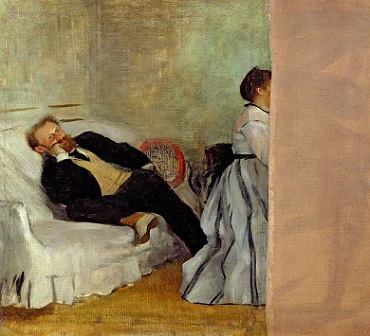
Our art course resumed for its autumn term yesterday on Zoom. We studied Edouard Manet and Edgar Degas.
Both came from wealthy families. Manet’s father was a lawyer and judge who – it is said – was reluctant for his son to be an artist until he married his father’s mistress and adopted his son.
 Manet was neither a realist nor an impressionist and if he is any ist it would be an individualist.
There is a constant debate in art – particularly in British art – between the figurative and abstract.
Those who favour figurative art say they like a story. If so Manet must be their champion. His best known works Dejeuner Sur L’Herbe, Olympia (1863) and A bar at the Folies-Bergere certainly tell a story, but what is it?
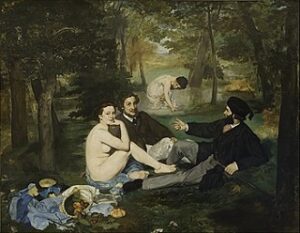 In the first, who is the woman picknicking and why is she nude ?
As our teacher said it is still a picture that has all the elements of traditional Academy painting:
– history panting
– landscape
– still life
– genre painting
– classical nudity
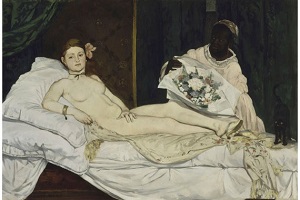 Olympia is even more arresting as the nude subject is looking challengingly at the viewer, covering her genitalia, and next to her her black maid is bringing a bouquet of flowers.
There is cat that symbolises lascivious pleasure (a dog symbolises fidelity and is often seen in family portraiture).
When it appeared in the Salon in 1865 one can imagine a rich bourgeois man, who kept a mistress and might have had sex with a black prostitute, being uncomfortable viewing it with his wife.
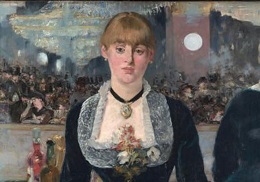 The Bar at the Folies – Bergers is another arresting picture.
The barmaid looks out blankly at the viewer and the mirror behind her reveals those present.
Who is the woman chatting to behind the barmaid?
Once again the subject of Manet’s picture is looking straight at the viewer.
 Edgar Degas’s objects take an altogether different stance as the painter adopts a more detached style.
Like Manet he was not an impressionist.
In his best known pictures, like the ballet scenes, he might have painted them from a box as it an aerial view.
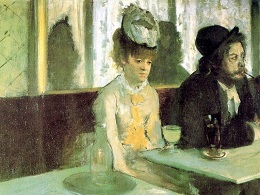 In the Absinthe Drinkers the subjects are, unlike Manet, in the background.
This depicts the isolation of the drinker looking for company with whom to drink but at heart a depressed, isolated person.
Degas had robust right wing views. He was a vocal supporter of the anti-Dreyfus group unlike Emile Zola, Dreyfus’ best known defender and friend to many artists of that era.
If Manet and Degas are difficult to classify there is no doubt of their place in history along with Paul Cezanne they were crucial in the development of twentieth century modernism.
