
My art week
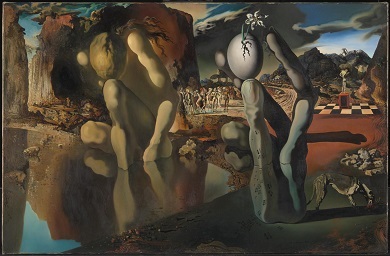
Last week I watched a SKY ARTS programme on Salvador Dali, and my art courses were on Dadaism and the Grand Tour.
Ostensibly there is nothing to link all three.
Indeed in their attack on Capitalism the Dadaists and Dali were polar opposites.
There is however – as I shall show – strong similarities between Dali and the Italian artists that pandered to those wealthy toffs that did the Grand Tour.
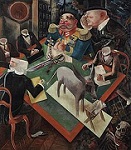 Dadaism was a loose movement that began in the Cafe Voltaire Zurich.
They attacked bourgeois and establishment values.
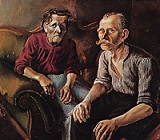 We studied its two most renowned artists George Gross – sometimes called the German Hogarth – and Otto Dix who depicted gloomy war studies as he fought in World War One and was scarred by the experience.
Our tutor began her lecture on the Grand Tour by calling it a money spinner and this it undoubtedly was.
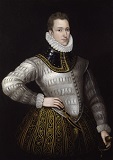 The first Grand Tourist Sir Philip Sidney was sponsored by Queen Elizabeth I to the tune of £1,500.
The Grand Tourist really became popular in the seventeenth century.
He or she was expected to bring some Italian classical antiquity or painting home and artists like Pompeo Batone, Piranesi, Canova and Canaletto were on hand to supply these at handsome prices.
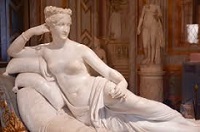 This is not to denigrate them.
Canova’s sculpture of Pauline Bonaparte in the Borghese Gallery in Rome is my favourite sculpture of all.
Canaletto was a vedutist (a painter of views) and immensely popular.
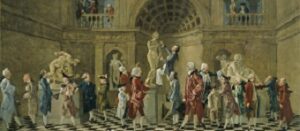 There was a sub-text to the Grand Tour – an opportunity for sexual gratification with your own and the opposite sex.
The Grand Tourist often brought something back home other than a piece or painting.
Salvador Dali was denigrated by his peers as greedy and one who sold his soul to commercial art.
 The founder of the Surrealist movement Andre Breton penned a Spanish acronym of Dali’s name ‘Avida Dollari ‘(“Greedy Dollars”).
Dali was expensively commissioned to advertise products and it is said that for $10,000 you could buy a blank piece of paper signed by him and do what you will with it.
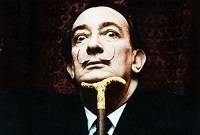 Much of his reputation was based upon his eccentricity.
He had those extraordinary moustachios and was a dandy.
His wife Gala was his manager.
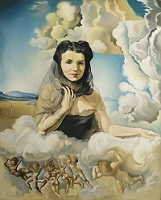 It was – one might say – a surreal relationship.
Her first husband was poet Paul Elouard. She had a voracious sexual appetite – her preference being a menage a trois.
Dali professed she was the only woman he had sex with in his life but he had many, er, muses, one of whom – Amanda Lear – was given much airtime in the programme.
Dali’s reputation has lowered over time.
When I first came across him, I knew him better than Miró.
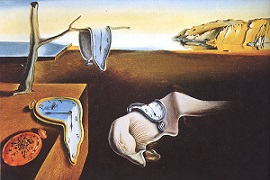
However his admiration of Franco, his unavowed love of lucre and his persona grated on me as my admiration for his floppy clocks and insects waned.
