
My art week.
A diverse art week this time.
It started on Monday when the Collector series on Sky Arts featured David Lewis who had used his fortune made in property to start a collection with his wife Hannah.
They began in the 1970s and their collection included a Pierre Bonnard, Van Dyck and other old Masters.
His fine eye was combined with self-acquired knowledge and he was always happy to lend out his collection sometimes for 30 years.
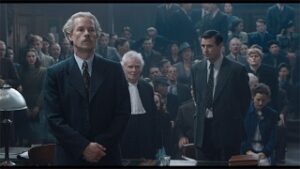 I then watched the film The Last Vermeer being the story of Hans van Megelem.
He was a master forger who sold a Vermeer to Herman Goering which the Reichsfuhrer so treasured he kept it with him rather than in his secretly stored hoard.
Van Megelem was denounced after the war and tried as a traitor immediately after the end of hostilities but his defence was that it was a forgery and he was conning the Reichsmarshal.
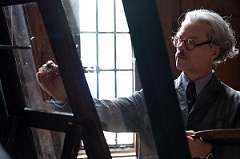 Guy Pearce played Van Megelem well for whom the phrase “bending with the wind” might have been invented. For example he gave Hitler an art book.
In passing, Hitler for an artist had execrable taste and I understand the exhibition he masterminded of degenerate art will soon be recreated.
Much of the film was centred on the trial in which Adrian Scarborough played Dirk Hannema the director of the Rijsksmuseum who unequivocally authenticated the Vermeer.
The portrayal was of a pompous, smug man but, rather like Bernard Berenson who “authenticated “ for art dealer Joseph Duveen, it showed that art experts are not much better than medical ones in the pandemic for accuracy.
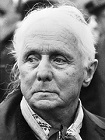 It was an artist who appeared in the Degenerate Exhibition – Max Ernst – we studied on our Tuesday course on surrealism.
Max Ernst, who married Peggy Guggenheim, had to flee to New York from the Nazis.
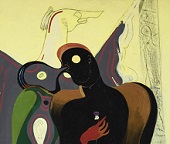 He also had a relationship with Leonora Carrington and a menage-a-trois with poet Paul Edouard and his wife Gala (later the wife of Salvador Dali).
Whilst of philosophical interest as surrealism trawls the subconscious its paintings don’t do it for me.
On Thursday we studied earlier romanticism in Western European art which incorporated Eugene Delacroix, Theodore Gericault and Caspar David Friedrich.
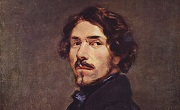 Delacroix was probably the illegitimate son of Marshal Talleyrand and much influenced by John Constable.
Constable never left Britain but the art dealer Arrowsmith brought The Hay Wain to Paris which Delacroix saw. His work then and later was immensely popular appearing on postage stamps.
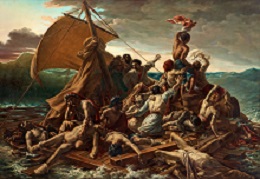 Gericault is best known for Raft of the Medusa, a boat full of slaves abandoned when the officers of the shipwrecked main vessel purloined the safety crafts for themselves.
The painting created quite a stir.
He also did some interesting sporting pictures of horse racing and pugilism.
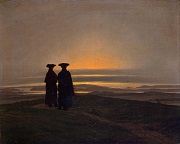 Caspar David Friedrich portrayed loneliness and solitude, typically those looking out of sea.
We finished with another whose work might drive you to an early suicide – Francisco Goya.
Though our course was entitled Romantics there was little romance in his subject matter.
The romantic movement was more about challenging: the interior v the exterior; tradition and history v the modern world; faith v superstition.
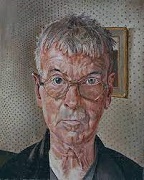 As an art lover I’m more interested in the quality of work then ‘isms’. This is one of the reasons I like 20th century British art: painters like Paul Nash, Stanley Spencer and Graham Sutherland are difficult to classify.
Art is derivative.
The lineage of Delacroix is Titian and Rubens. He was a great friend of Gericault, who died young, and finished some of his work.
Goya influenced many not least the Young British artists the Chapman Brothers. Goya was a massive admirer of Velazquez, Rothko of Friedrich, Picasso of el Greco .
And so it goes on….
