
Tea with Mussolini
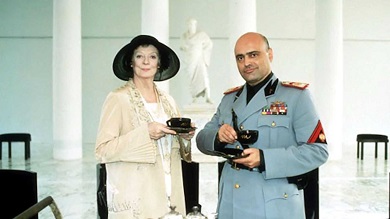
Stefano Ursolini writes:
 Neil Rosen asked for my comments on this film directed by that eminent Florentine Franco Zeffirelli.
It depicts his youth.
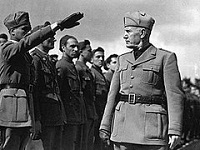 He was the illegitimate son of a Florentine businessman who ran way aged 16 to join the partisans and enlisted with the Scots Guards in the difficult Allied push up Italy after landing in Salerno in 1943.
It was a tough campaign of awful weather and the egoism of US Commander Mark Clark.
 Mussolini had surrendered in September 1943 but the Nazis got him out of prison.
Field Marshal Kesselring organised an effective German defence of Northern Italy and Florence was occupied by them.
Many Jews were rounded up. Zeffirelli did well to escape.
 I do not know whether it was strictly accurate that he was brought up by Mary Wallace (Joan Plowright) but certainly he shared her deep love of Shakespeare and one of his most celebrated films is Romeo and Juliet with Leonard Whiting and Olivia Hussey.
He also produced much opera.
In 1995 I was in London seeking to purchase a de Chrico from the Estorick Gallery.
 By happy circumstance I was also invited to the launch of the Viola Club di Londra at the Hyde Park Hotel.
Fiorentina were playing Juventus.
Zeffirelli and conductor Georg Solti, who lived in Florence, were present.
 When Fiorentina scored to go 2 up one supporter threw his chair up which shattered an expensive chandelier.
Zeffirelli complimented him on his passion!
One of my favourite parts of the film is when the young Zeffirelli scores a goal in his Viola shirt.
I thought the film was a wonderful portrait of both Zeffirelli and Florence before and during the war.
Stefano is better equipped to comment on Zeffirelli and Florence.
The film has another dimension too.
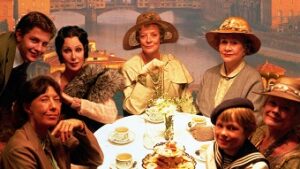 It is the stirring story of resistance by a group of posh English women called the Serpents who convene at the fashionable tea house Doneys.
One of them the formidable Lady Hester Ransom (Maggie Smith) is totally taken in by Mussolini.
The group is joined by the wealthy Jewish Elsa (Cher) to whom Lady Hester takes a strong dislike.
Another member of the art group is a passionate art lover played by Judi Dench.
It is a precursor to many a film of mobilised female resistance like Made in Dagenham and a wonderful showcase for three magnificent theatrical dames.
