
The BBC – it was not ever thus
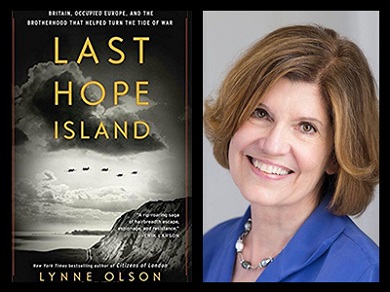
I am reading an excellent book – Last Hope Island by Lynne Olson.
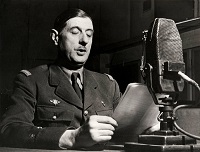 It is an account of how many Europeans notably heads of government, or self-styled ones like Charles de Gaulle, came to the UK in 1940 as it was the only substantial western European democracy not under the Nazi jack boot.
The BBC played an important role in keeping the beacon of hope alive.
King Haakon of Norway broadcast his refusal to abdicate in favour of the Quisling puppet government.
Queen Wilhelmina of the Netherlands delivered a broadcast against the Nazis in such coarse language that her own grandchildren were forbidden to listen to it.
 Leon Blum, a former French premier who was handed over to the Nazis in 1943 and ended his days in Buchenwald, commented:
“In a world full of poison , the BBC became the great antiseptic.”
A graduate of Nenwham College Cambridge, Cecilia Reeves set up the European service.
 She recruited a French theatre producer Michel Saint Denis.
Denis produced a hallmark production of The Three Sisters with Peggy Ashcroft, John Gielgud and Michael Redgrave and later founded the Royal Vic.
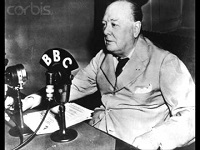 It was agreed that Winston Churchill would address the vanquished across the channel.
In typical fashion he opened with these words:
“C’est moi , Churchill, qui vous parle …“
The broadcast had to be made in a makeshift studio in the war rooms. These were so cramped that Michel Saint Denis sat on Churchill’s lap throughout.
You cannot over-estimate the effect on the War of the BBC which, of course, also broadcast those obscure word coded messages to resistance groups like “The crocuses are late this year.”
People literally risked their lives to listen but listen they did.
The BBC was a prime force in the V-for-Victory campaign too, which so impressed Goebbels that he copied it.
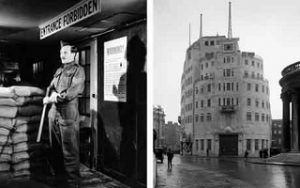 The BBC in Portland Place was sandbagged and the European service moved to Bush House. So those broadcasting did so under frightening conditions as the BBC was a prime Luftwaffe target.
Bernard Montgomery was appalled by the working conditions of Bush House when he visited for a broadcast.
One can only imagine the moaning – and indeed legal claims – if present BBC employees had to work under such conditions, yet then and there there was a real esprit de corps.
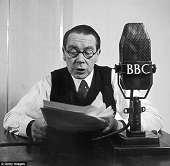 The BBC underwent quite a change during the War.
Pre-War John Reith, the austere Director General, saw it as more the government’s mouthpiece.
Harold Nicolson was banned for making an anti-appeasement broadcast.
Broadcasters spoke in plummy voices in dinner jackets. Under talented people like R.T Clark, Noel Newsome and the historian Alan Bullock there was greater independence and dedication to the truth.
How different was the wartime BBC to that of today.
I doubt if any nowadays would risk their lives to listen to it.
