
The Calcutta Cup goes north
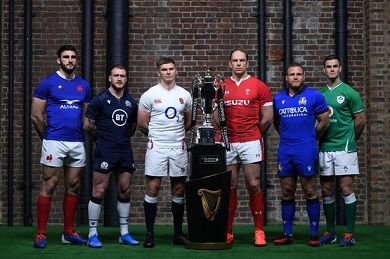
The beginning of the Six Nations tournament is one of my annual sporting milestones because, as an oldie, it instantly re-connects me with both my youth and the golden years of rugby union in the British Isles which – with a broad brush approach – I would cite as being roughly between 1965 and 1974.
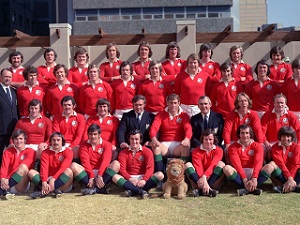 The latter was, of course, the year of the “Invincibles” British Lions tour of South Africa, captained by the legendary Willie John McBride, complete with its famous “99” call designed to combat the South African players’ penchant at the time for systematic violence designed to injure or intimidate foreign touring teams.
The concept was that, upon the call being given, every Lion on the pitch would begin laying into an opponent and it didn’t matter who. The intention was to demonstrate to the locals that the Lions were perfectly prepared to meet “fire with fire”, an underlying theory behind the tactic being that referees were unlikely to have the cojones to send off the entire team.
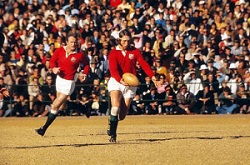 Here’s some footage of the famous Third Test at Port Elizabeth on 13th July 1974 (also known as “the Battle of Boet Erasmus Stadium”), one of the most violent in history, which the Lions won 26-9.
During it the Lions “99” call went out. The subsequent “action” included the sight of the Welsh Lions full back J.P.R. Williams running 45 yards to launch himself into the giant Springbok lock Johannes “Moaner” van Heerden, something that, years later, he admitted he “was not particularly proud of”.
With apologies for the grainy and silent footage, see here for some video of the incident, courtesy of – YOUTUBE
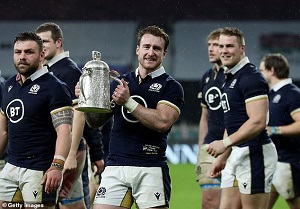 But back to yesterday.
In view of the occasion my weekend had in prospect been built around a Saturday afternoon to be spent watching the Calcutta Cup match between England and Scotland at a Twickenham Stadium devoid of a crowd (kick off 4.45pm).
In advance I had acquired myself a ready-made meal of beef shin casserole, plus mashed potato and mixed vegetables bought at Sainsburys, a bottle of red plonk, a bag of hot cross buns and an ice cream.
Accordingly, at 4.15pm I duly settled down in front of the television to watch ITV’s live coverage which came complete with all the usual suspects including (as pundits) Jonny Wilkinson, Sir Clive Woodward, towering former Scottish lock Jim Hamilton and Lawrence Dallaglio.
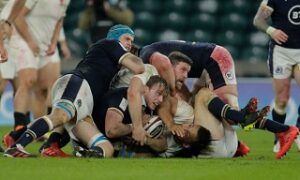 From a home supporter’s point of view what followed was one of the most abject non-performances I have ever witnessed from an England team as they succumbed by the margin of 6-11 to Scotland for the first time at Twickenham in 38 years.
Two points here:
Firstly, I wish to take nothing away from Scotland who thoroughly deserved their win.
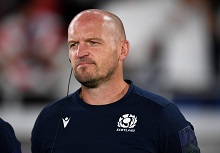 Over the past three seasons under head coach Gregor Townsend they have pulled together a tough, uncompromising squad of players, some of them very talented indeed, and had arrived in the capital with a set of strategy and tactics specifically designed to cause an upset.
And they delivered. Their captain Stuart Hogg, who now plays his club rugby in the English Premiership with Exeter Chiefs, had an outstanding game but every man jack stuck to his assigned task to the final whistle.
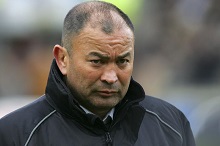 Secondly, it’s difficult to know where to begin in apportioning blame for England’s demise on the day.
One doesn’t want to be a fair-weather friend who turns about-face the moment things begin going wrong, but (in my view) Eddie Jones – who after the match typically took full responsibility for what happened – needs to have a serious talk with himself.
It shouldn’t be too hard – he’s built his worldwide reputation as a coach on telling players and others brutal home truths and constantly challenging everyone to improve.
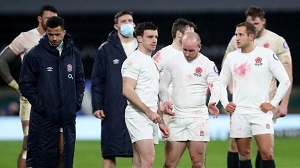 The trouble is that, from time to time over the past four seasons, too often England have delivered half-baked performances both in the Six Nations and, of course, most disappointingly in the 2019 Rugby World Cup Final in Japan.
Personally – and I have no pleasure in writing this – my long-held view (which flies in the face of plenty of statistical contrary evidence) is that England captain Owen Farrell is at the root of what is wrong.
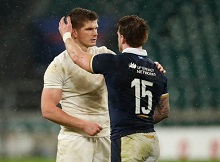 He is as tough and strong as teak and uncompromising. He’s a great rugby player, world class in several respects including kicking and temperament, but he also has distinct weaknesses (e.g. tackling technique and his lack of leadership qualities).
He’s certainly worth his place in an international squad but – for me – not in the starting XV and not as captain.
The England set-up has a huge and talented player-base to choose from and should automatically win most Six Nations tournaments. Eddie Jones has livened things up with his maverick call-ups and most who come into his atmosphere testify to the electrifying impact he has had upon them.
And yet England regularly under-perform. On paper yesterday’s matchday 23 looked good enough to put 25 points minimum on the Scots. I dare say Eddie Jones could easily have picked an alternative 23 of whom exactly the same could have been predicted.
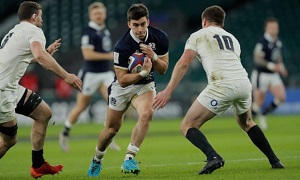 At Twickenham yesterday the Scots got on the front foot almost from the first whistle – stuck to their game plan like stoats – and never looked back.
In contrast, England – for all their “huff and puff”, time in camp, high class conditioning work and planning for all eventualities – barely got into the game, or indeed out of second gear.
One last disparaging comment as I conclude.
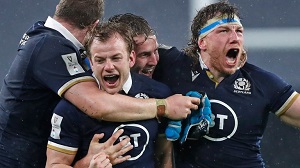 One of rugby’s enduring plusses is that quite often a score-line can be entirely at odds with the quality of intensity/excitement in the match.
Depending upon circumstances, sometimes a match ending 6-11 can be a far more absorbing watch than one finishing 55-45.
Yesterday’s 6-11 victory was a brilliant one for Scotland but frankly – as rugby entertainment – it was a damp squib.
This can happen in any sport when one team just doesn’t turn up.
