
The Flemish House/Georges Simenon
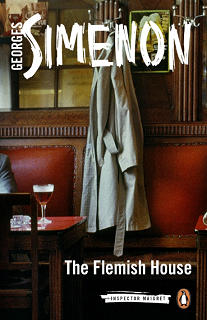
Georges Simenon is one of those authors many have heard of but less have read. Older readers will recalling actor Rupert Davies definitively in the role of the bulky French detective in his trademark raincoat and pipe. A good friend of mine and the Rust presented me with a copy of The Flemish House. He praised the quality of the language, the economy of characters (8) and the esteem of Simenon among his peers.
I was particularly impressed that Simenon set the place, Givet, a town just over the French Belgian border on the River Meuse, so vividly. The mystery is the disappearance of Christine Piedbeouf a Walloon. She had a relationship with a Flemish student lawyer Joseph Pieters, a child by him and his wealthy Flemish family wanted to end it. Maigret is requested by one member of the family Anne Pieters to investigate the disappearance. He works alongside the local inspector of police, Machere . Machere is a walloonand the novel depicts the seep social divisions in Belgian society well, divisions that exist to this day
Whilst I could only admire the writing I was less enthusiastic about the detection. Unless I missed something the process of detection and identification of the culprit was not that clear and when Maigret forces the perpetrator to confess he does not feel obliged to turn that person in. All very odd. The novel is only 145 pages long and as my friend observed you can only admire the economy of phrase and depiction of place and character.
Jean Claude Izzo wrote an excellent trilogy set in Marseilles which spawned the Mediterranean noir movement. Again the writing is superior to the detection but the atmosphere and flavour of Marseilles, its smells, food and corruption is brilliantly evoked. For more orthodox if elliptical French crime writing I would recommend Fred Vargas, actually a woman , whose crime novels contain many a twist and surprise.
