
The Great Train Robbery (2013 two part film)

Yesterday over lunch I discussed with a friend roughly my age the seismic events of out lifetime: the assassination of President Kennedy, the landing on the moon, the killing of John Lennon, the death of Princess Diana and the Great Train Robbery.
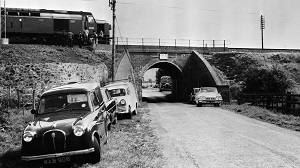 The sheer audacity of the gang, who on August 8th 1963 robbed a Royal Mail train of £2.6m (£41m in today’s money) in used bank notes, still occupies popular imagination and many books have been written and films made.
One such was this BBC two-parter divided into The Robber’s Tale and The Copper’s Tale.
 The Robber’s Tale dealt withe formation of the gang under Bruce Reynolds and the planning of the robbery.
Reynolds had little experience of robbing a train and took the assistance of a south coast specialised firm. One of them Jack Cordery, a Brighton florist, knew how to alter the signals before Mentmore Bridge where the train would be halted and the mail carriage robbed.
 The only contribution of Ronnie Biggs was to find an auxiliary train driver who was never used.
The only act of violence was to cosh the actual driver Jack Mills.
 The robbers acquired Leatherslade Farm some 30 miles way where the cash was stashed.
This acquisition was undertaken by a dishonest solicitor’s clerk Brian Field known to one of the gang leaders Gordon Goody.
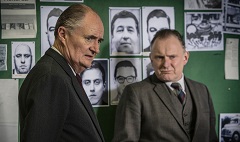
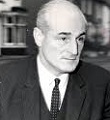 The second part – The Copper’s Tale – covered the hunting down of the gang by Chief Superintendent Tommy Butler, a dogged but autocratic officer who drove his team hard.
He soon located the farm as a remark to the guards to “lie down for half an hour” implied the safe house was within a 30 mile radius.
A tip-off came from a suspicious neighbouring farmer.
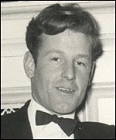 The link to Field was soon established.
Butler’s number two Frank Williams had a notable collection of snouts and soon a list of suspects – with Reynolds at the head – was formed.
The gang split up with a stash of £100,000 each. Most but not all of the money was recovered.
The weak link was Field who did not ensure the farm was burned down so vital “dabs” were obtained.
 There are number of unresolved questions which may never be answered.
What was the identity of the Ulsterman who tipped them off?
Did the Flying Squad not noted for their probity at this time help themselves to some of the proceeds?
Were all the gang caught?
One, alleged to be free, was so careful that he always urinated outside.
 Reynolds and Charlie Wilson who escaped from Parkhurst finished up in Canada after Mexico: Biggs, another escapee, in Brazil via Australia.
They spent their loot, some of it (rumoured to be £30,000) on legal fees.
The sentencing of Mr Justice Davies – of 30 years – attracted some bewilderment.
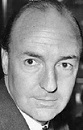 Reynolds and others argued that in future robbers might as well go armed as there was not a higher tariff in sentencing for that.
My feeling is that, coming after the Profumo scandal, the Establishment was rocking and orders came from up high for strong sentencing.
I recall a conversation in a pub with a drinker who was an authority on crime.
 He said the job was offered to Billy Hill, who was alleged to be behind the Eastcastle St Post Office robbery in 1952 without a single person arrested or charged, but he thought the gang too young – most were in their early 30s – and too large.
 As for the Flying Squad, the appointment of Robert Mark as Chief Commissioner put an end to the too-cosy relationship between officers and narks.
This drama had a strong script and fine performances from Jim Broadbent as Butler and Robert Glenister as Frank Williams.
