
The honeymoon is over – so where’s the beef?
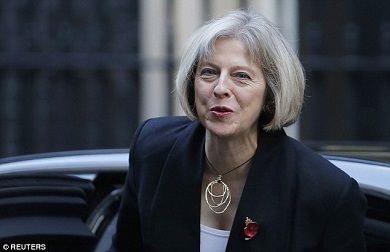
One British political myth – or is it truth – combining both received opinion and straight history is that, whereas the Labour Party is at continual war with itself over ideological issues and in particular engages in prolonged leadership battles, the Tory Party is eternally better off because the only thing that ever divides it is Europe and it has always been a dab hand at resolving its leadership crises swiftly and with brutal ruthlessness (in May 2016 one Tory MP rebel was quoted in The Sunday Times as saying of David Cameron: “I don’t want to stab the Prime Minister in the back — I want to stab him in the front so I can see the expression on his face …”).
One could suggest that the circumstance in which Theresa May ascended to the throne in Number 10 Downing Street after the EUR Referendum was a mainstream case in point.
One negative legacy of Labour’s traumatic loss at the May 2015 – this probably unnoticed by anyone within its ranks at the time – sprang from the strange but presumably well-intended leadership electoral system left behind by the outgoing incumbent, bacon sandwich-gnashing Ed Miliband.
It led directly to the ‘accidental’ emergence of Jeremy Corbyn as a serious contender for the leadership and a period of the wishes of the Parliamentary Party being swept aside in a wave of what is now fashionably and derogatorily termed ‘popularism’ – albeit unusually in Labour’s case of a leftie, i.e. rather than loony-right (UKIP/Trump/Farage/ Marine Le Pen/Nazi) kind.
This could be a candidate for the first prediction of 2017 to be proved catastrophically wrong, but – from where I’m sitting – it would seem that, given its current state of disarray, it will be years rather than months (if ever) before Labour again becomes a proper Opposition in the UK Parliament.
 Contrast this with the events of last June/July in the Tory Party.
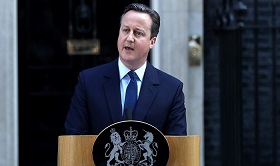
Although before the EU Referendum David Cameron had specifically maintained that, even if the UK voted Leave, he would remain as Prime Minister in order to skipper the necessary negotiations by which it happened, he wisely either thought that through and/or took sound advice and within hours was standing at a lectern in Downing Street announcing his resignation.
With Labour wrestling its own demons, it was almost as if the Tory Party was determined to prove every stereotypical myth about itself correct in acting decisively over the process of ditching Cameron and replacing him with a new leader/Prime Minister.
With a swiftness that would have been admired by Maoists in Communist China, almost overnight the Tory Party machine had effectively erased ‘loser’ Cameron from history and embarked upon a deliberately-short leadership race, no doubt in the hope of changing jockeys on the proverbial ‘horse of state’ before the punters had even noticed.
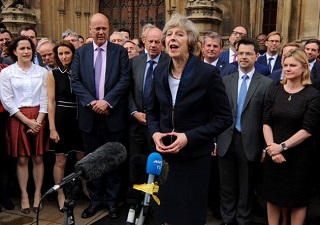 In the event, of course, their ‘leadership issue’ was resolved more quickly and brutally than even the archest and most inventive of their policy wonks could possibly have imagined. The shocking, weird, even thrilling, course of the 2016 Tory leadership battle will be remembered vividly by everyone who lived through it.
As the 24-hour media outlets engaged in an unequal struggle to update their ‘breaking news’ ticker-tapes fast enough to cover every twist and turn of the campaign – each seemingly more extraordinary and bonkers than its predecessor – the whole Stephen Crabb/Liam Fox/Theresa May/Andrea Leadsom/Boris Johnson/Michael Gove saga unfolded at bewildering speed.
My hunch is either that this was allowed to happen by deliberate design of someone – or some committee – somewhere high up in Tory HQ or, alternatively, (once things became seriously anarchic, vicious and bloody to the point of being out of control), the word had gone out to down tools in terms of trying to ‘manage’ it in PR terms on the basis that the sooner it was all over the better.
And, of course, also sooner forgotten by the public.
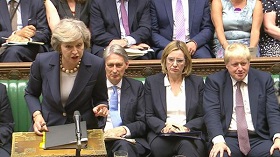 As we enter 2017, it is perhaps an appropriate moment to review Mrs May’s first six months as Premier.
Let’s trot out the caveats straight away. Every new leader tends to be given the benefit of an initial ‘honeymoon period’ and also, of course – against the background of the Brexit decision, Labour’s ongoing travails and the arrival of Donald Trump in the White House – there’s an extent to which quite properly it can and perhaps should be a case of ‘the jury’s still out’ for a while yet.
Nevertheless, there’s a natural tendency in all of us in a situation like this to start from the perception of someone we have historically formed over the years and then add to (or subtract from) that impression based upon what we now see or hear.
Hitherto, Theresa May has been historically seen as a hard worker, kitten heels, trousers, a sort of humourless Mrs-Thatcher-lite scolding union and/or Police Federation conferences from the podium, the famous “We are the Nasty Party” speech … and as the Home Secretary who talked loud and long about stemming the tide of UK immigration but achieved very little.
I suspect those are foundations of her reputation in the eyes of the bulk of the UK electorate. Her self-projected image during the ‘blink and you’ll miss it’ Tory leadership campaign was that of a ‘no nonsense safe pair of hands’ combined with an attempt to distance and differentiate herself from Boris, and perhaps the other candidates, by self-deprecatingly stating that she was not the kind you’d ever find smooching up to fellow MPs in the bar.
Once everyone else had committed murder or hara-kiri (or both) – and their supporters had mysteriously melted away – Mrs May became the only candidate left and everyone immediately closed ranks and said they’d always secretly supported her anyway.
How did she react upon being anointed?
Worryingly, she arrived in Downing Street doing her ‘Mrs-Thatcher-lite’ impression, giving a disappointing wishy-washy speech to the nation in front of the cameras that she presumably had intended would be a rallying call to all, including the downtrodden ‘huddled masses’. This was where I began to turn against her. It sounded insincere and counter-intuitive coming as it did from someone with a reputation for telling it like it is and not sparing sensitivities.
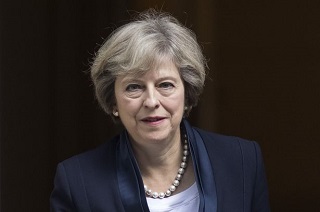 Furthermore, she has seemed not to score many runs with her general attitude to explaining the Government’s position on Brexit at home or abroad (assuming there is one) and, it has to be said, in dealing with most issues that have come the Government’s way.
Over the Christmas period, from two different family members, I heard supposedly ‘insider’ views on Mrs May as a political operator and Government minister. One of them was first hand and the other second hand – both of them were similar and neither of them greatly favourable.
In short, they amounted to the fact that our new Prime Minister is undoubtedly a hard worker. That she is not a dynamic decision-taker, more a vacillating ditherer. That she is not a natural or clubbable leader. That she’s a control freak who likes to micro-manage and is a hopeless delegator.
All this may have worked fine – or just about okay – when she was in charge of a single department (e.g. the Home Office), but it’s a millstone now that she is in charge of the Government.
There’s an old adage that applies to almost every organisation known to human beings: ‘as is the leader, so is the government’.
The other thing that occurred to me today was that, not so long ago, there was a leader of another UK Party who shared many of the above traits and attributes, viz. Gordon Brown.
Technically – just like Mrs May – he was anointed (rather than elected) to the leadership of his party and thence became Prime Minister without having been voted into the position by the UK electorate.
Perhaps there the similarities end. Or perhaps not.
Either way, it doesn’t bode too well for our medium-term future, does it?
