
The lessons of Dublin may not be learned by some
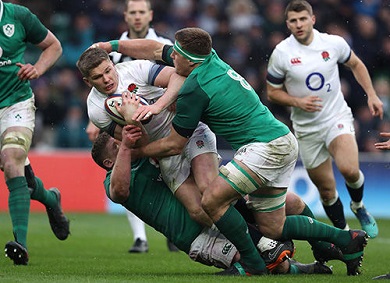
It is not easy being an England rugby union supporters at the moment.
 I very much doubt that anyone like me who troubled to watch yesterday’s match in Dublin on television in which Ireland effectively humiliated “our boys” 32-18 – a margin, incidentally, that did not flatter the hosts – was expecting a turnaround in fortunes, still less a renaissance.
However, to finish the 2021 Six Nations in fifth position – nobody counts Italy these days, who yet again collected the wooden spoon for being 10 league points behind even England, and have now lost 32 consecutive matches in the tournament – is a disaster for the country with the biggest player basis in Europe and a governing body (the RFU) which is possibly the richest in the world, or ought to be if it wasn’t so poorly run.
 One must be careful of falling prey to the journo’s stereotypical tendency of fawning over teams and coaches when they’re on a winning streak and yet labelling them terminally-incompetent losers the moment they have a single reverse but it’s at least arguable that, despite winning the Six Nations in 2017 and 2020 and reaching the 2019 Rugby World Cup final, Eddie Jones’s England have actually been in decline since 2018.
My father held to the view that, irrespective of how successful it was, every business worth its salt should have a major overhaul of its key board-level executives at least once every five years and – when it comes to sport – I’d argue that it should actually be every four years, i.e. the length of a World Cup and/or Olympic cycle.
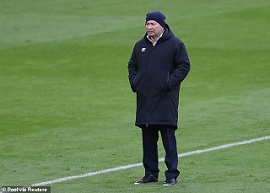 The England hierarchy is current paying the price for its mistake in renewing Jones’ contract through to the 2023 Rugby World Cup campaign even before the 2019 one took place.
The adage “If it ain’t broke, don’t fix it” just doesn’t apply in sport, even when it comes to mavericks like the abrasive Australian whose stock in trade is constantly turning everything upside down under the guise of keeping everyone guessing and on their toes in the cause of making them “battle ready”.
[I apologise here if I now seem to be doing exactly what I stated above scribes should be wary of!].
In making my case for the prosecution I am suggesting that – quality coach, iconoclastic, demanding (not least upon himself) workaholic, spikey and humorous as Eddie Jones undoubtedly is – the fact is, to a degree, he’s an emperor who wears no clothes.
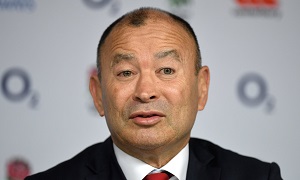 Yes, he’s unearthed from practically nowhere the occasional world class player like Tom Curry, but when you review in depth the list of over 50 players that he’s plucked from relative obscurity over the course of his tenure to join his England structure and atmosphere, often at very tender ages, those who have fallen by the wayside or been summarily discarded after a few (or even no) caps are legion.
Is it unworthy of me to put the case before the jury of England supporters everywhere that – if you simply pick enough young promising players and “thrown them up in the air” (or, to put it another way, “chuck them into the caldron that is international rugby”) – the law of averages says that at least 5% to 10% will make the grade?
My contention is that the Eddie Jones version of being an international head coach is not the kind that puts in place a dynamic structured system for identifying new talent and then nurtures it carefully to ultimate fruition by one day taking its rightful place in a matchday 23.
After all, it is in the nature of things that young talented exponents of any art or skill develop at different speeds.
 Some sporting ones – let’s for the example take footballers and cite Lionel Messi, Cristiano Ronaldo (and back from my heyday, the likes of George Best and Diego Maradona) – burst onto the scene as virtually fully-formed global superstars whilst still teenagers, whilst others need time – sometimes years – to mature, “grow into their strength”, gradually hone their skills, develop new ones and/or perhaps expunge their weaknesses.
Could it now be the case that Eddie Jones has been “found out”?
Could it be that he has no plan at all, but simply excels at challenging the existing order?
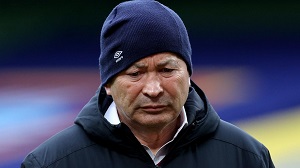 It definitely “spices things up” for a while, of course, and he keeps everyone (not least players, rugby correspondents and indeed national supporters) on their toes by entertaining them – he gives great interviews and never takes prisoners.
Furthermore, runs my argument, all the while he “maintains the illusion” by claiming every England success as another intended stage in the development journey of his team … and conversely reacts to by every loss or reverse by immediately (and some might say bravely) “taking full personal responsibility for it” and claiming that it is proof of “how far there is yet to go” in order to deflect the heat from his players and perhaps also keep them believing in him?
Thinking overnight, and I’m no football expert, it occurred to me that quite possibly Eddie Jones has a kindred spirit/counterpart currently working – albeit perhaps not for much longer – in England’s Premier League.
 Step forward, Jose Mourinho – head coach of Tottenham Hotspur.
Talented, experienced, hard worker, arrogant he may be – possibly even a visionary.
Spikey and entertaining – another good interviewee guaranteed to provide an amusing or controversial quote for every occasion – he certainly is.
And yet somehow, it seems, everywhere he takes charge – I don’t know the full list, but Chelsea (twice), Manchester United and Spurs all feature – he produces a near-instant “lift” for all concerned which lasts for a certain period but then always seems to end in pain, suffering, resentment and then massive disappointment and/or disaster before a seemingly inevitable parting of the ways.
Are Eddie and Jose peas from the same pod, I wonder?
