
This House/ Chichester Festival Theatre
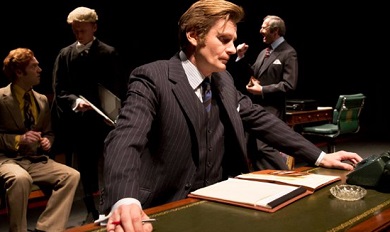
If you were an aspiring playwright your play would be unlikely to be about the machinations of the Whips Offices of both parties in the Labour government of 1974-79. Yet this was precisely what James Graham wrote successfully in This House. This was first dramatised at the National Theatre in 2012 and revived at Chichester. The 2012 director Jerermy Herrin and some of the original cast were in this production
The play begins with the Labour Chief Whip, the south London bruiser B0b Mellish ( Phil Daniels ),and his deputy Walter Lawrence ( Steffan Rhodri) at a meeting working out his Labour will stay in power in 1974 without a working majority. The essence of the drama is the conflict withe Tory whip’s office led by the more bespoke patrician Humphrey Atkins (Malcolm Sinclair) . I use the word “conflict”as matters reached such a fever pitch that Michael Hesletine famously wielded the mace but reality is that there was a grudging admiration that transcended the class and political divide. The pairing convention was stretched to its ultimate point and sick MPs like the one for Batley ( Christopher Godwin)could be counted in an ambulance. Deals were struck with small minority parties like the Scottish Nationalist and Ulster Unionists . As my Labour friend observed once to me you could not actually govern let alone usher in a truly Socialist agenda such as Roy Jenkins did as Home Secretary, they just had to stay in power for power’s sake. Little wonder that the decisive Margaret Thatcher was elected at the end of the decade. The play might seem dated but so is the Chicheter audience . References to a referendum on Europe and the militant tendency sent a ripple round the auditorium.
Clearly James Graham has the benefit of advice from those in parliament at that time. He understand the language of the whip’s office. The vast raft of non-ministerial MPs are referred to as “the odds and sods”. An MP is only referred to by their constituency: Ebbw Vale ( Michael Foot) Finchley (Mrs Thatcher) Walsall North (John Stonehouse). Stonehouse’s “drowning” is dramatised by a vain beach boy being subsumed except for his head by a large blue cloth. The play too is always rich in humour in the dialogue.
The acting is of an uniformly high standard. In a typical Shaftesbury Avenue Production you might find one “name” say Felicity Kendall, a couple of reliable old stagers and some young actors of varying talent. Here there was not one lagger. The accents be they northern, midland or working class cockney were meticulously accurate and the sense of period authenticity was heightened by the seventies dress. The only critique was a two piece guitar band whose music was not of that era. The songs of Abba, Mud, Sweet and Slade would have been an improvement. A clever touch was to have the first thre rows of sweating identical to the Commons green benches with the dueling line too
The playwright did not take a political stance. One felt that his sympathies probably lay with the Labour side but in an unlikely twist a Conservative whip is prepared to fall on his sword to conform personally to a pair. There is some dramatic licence and key events like Jim Callaghan’s refusal to go to the country after the conference in 1978 was omitted. This would have avoided the Winter of Discontent that ushered in a significant Tory victory under Margaret Thatcher The Lib/Lab pact only lasted 6 months as Labour went to the country and achieved a majority of 3.. There was some reforming legislation in housing and social security but the period was largely remembered for 10% inflation. unemployment of over one million and industrial strife. That Labour survived it was largely due to the operators in the Whips office which the play does so well to convey.
