
What’s going on (as Marvin Gaye used to warble)
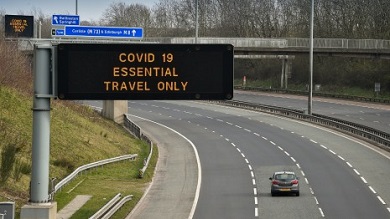
These are strange times and, the longer the Coronavirus crisis continues, the more I grow concerned about where the 21st Century world of the internet, smartphones and social media is taking us.
Overnight I rose to the accompaniment of a phone-in programme on Radio Five Live as I toured the newspaper websites in order to catch up on where we had reached since I went to bed some four hours previously.
 It was a sobering experience.
Boris has been admitted to hospital because the effects of his virus infection persist.
Doctor Catherine Calderwood, Scotland’s chief medical adviser, has succumbed to the inevitable and resigned after twice ignoring her own advice to not travel unless absolutely necessary and being spoken to by the police.
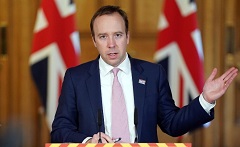 Health Secretary Matt Hancock, presumably regarded as an impressive performer at the Government’s daily press briefings because he’s doing a lot of them, is fast running out of capital because his assertive claims that the Government is in control of what’s going on and that 100,000 tests per day will be the norm by the end of the month increasingly seem to be at stark variance with what’s actually happening and any preparedness on behalf of the authorities to meet that target.
Let’s deal with those items first.
Hopefully the Prime Minister’s move to hospital is simply precautionary but frankly I’d have preferred it if he’d handed over [is Dominic Rabb the Foreign Secretary his nominated stand-in?] for the duration and we’d heard nothing more about it until he was fit, out again and back in charge. Or not.
Any sane person – and I’m not saying this because I’m English – would have spotted that Doctor Calderwood should have resigned immediately her ‘error’ became public knowledge. Her position was untenable for the obvious reasons.
Okay, gone are the days when political ministers took personal responsibility for their departments [oh for the days of Lord Carrington, Foreign Secretary at the time the Falklands War broke out in 1982, who ‘fell on his sword’ in the grand manner when nobody could have blamed him personally for the Foreign Office’s ‘failings’ in the run up to it yet he insisted on going as a matter of principle] but, given what she’d done Doctor Calderwood’s departure was inevitable.
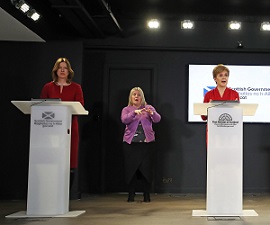 I listened yesterday to the excruciating press conference in which Scottish first Minister Nicola Sturgeon sought simultaneously to distance herself from Calderwood’s cock-up and yet insist that she was only human and anyway she (Sturgeon) wished to retain her wisdom and advice in dealing with the Coronavirus crisis.
Wrong, Mrs Sturgeon!
I repeat Doctor Calderwood, who hitherto had ‘fronted’ the Scottish Government’s public campaign to get people to stay indoors and observe its advice, had committed a cardinal sin and had to go.
The notion that she should stay because Sturgeon so valued her advice was both fatuous and ridiculous: Calderwood could have resigned and been replaced by another doctor [I presume Scotland could have dragged one up from somewhere], and yet carried on giving Sturgeon her advice as before – but behind the scenes.
That these modern ‘here today, gone tomorrow’ politicians don’t get these fundamentals of integrity and honour is just par for the course.
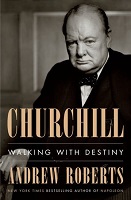 Last night, waiting to see the Queen’s address to the nation at 8.00pm, I returned to the WW2 wartime pages of my copy of Andrew Roberts’ recent biography Churchill: Walking With Destiny [Allen Lane, 2018, £35].
The inescapable contrast between now and then is that in wartime (and, for all the allusions to the Coronavirus crisis being a “war”, in reality it isn’t) to survive let alone emerge victorious, those in power cannot afford to flaff about dealing in the niceties of normal’ peacetime ranks, seniority or past service.
You need to harness the energy, vision, creativity and dynamism of “the best”, whether they be misfits and chancers who were pretty hopeless in peacetime military service (e.g. David Stirling, founder of the SAS), brilliant but maverick minds who didn’t quite fit (Alan Turing, aged 26 when War was declared in 1939, who is now recognised as one of the geniuses of Bletchley Park) or the incongruous (the ‘marmite’, some might say obnoxious, figure of Canadian Max Beaverbrook, aged 61 when Churchill picked him to be Minister of Aircraft Production in May 1940).
You’re not interested in rules, conventions or whose “Buggin’s turn” it is. You need people around you who will deliver.
There’s a place for leadership and oratory, of course, in times of crisis but – when the chips are really down – looking good in front of a camera and/or having a degree of “the people’ touch” about you is a minor consideration compared to coming up with solutions that actually work.
 Which brings me back to my opening remarks.
“The medium is the message” – the famous theory of Marshall McLuhan [see his 1964 book Understanding Media: The Extensions of Man] – has now taken over the world.
As I toured the current concerns of the popular UK press, filled as they are with the latest set-up photo spreads of hundreds of vacuous minor celebrities famous for being nothing more than being alumni of reality TV shows and/or sex scandals that I’ve never heard of; advice on the latest ‘in’  fashions to wear whilst you’re under ‘lock down’; how your kids are driving you nuts; your latest spoof videos that have gone viral; and, of course, the thrills (or problems) involved with online dating, phone sex and/or moving in with the person you bonked the night before the lock down began and now realise you have nothing in common with, I began to despair.
What a depressing place our supposedly-wonderful world of modern technology and means of communication has become!
About an hour or so ago, after listening to an unhinged lady on the radio ranting that it would be unfair if the Government banned everyone from going out at all just because a few idiots weren’t following the Government’s lock-down advice, I couldn’t help but contemplate what a better place the world might be if idiots were forbidden to air their views at all.
Or alternatively, if social media and the internet had never been invented. (It amounts to the same thing).
