
Women and sport
Unlike some of my male colleagues who are making great play of the fact they won’t be watching Rio 2016 as if there is some hardship involved in their decision, I am having an Olympics-free summer with no difficulty or regrets at all – largely because I have enjoyed a totally sports-free life since about 1971 and am quite sure I’m better for it.
That said, like everyone alive in the 21st Century, I have a passing connection with some elements of social media (I shan’t bother you with which ones, partly because I’m sure this would demonstrate how sadly behind the times I am) and therefore have been unable to avoid doing some amateur monitoring of the weird relationship between human females generally – both as participants and spectators – and the Olympics now taking place in South America.
I take as my text today three representative articles:
Hannah Smith’s article I don’t know whether to be more offended by volleyball players covered in a birkini or exposed in a bikini, as appears today on the website of – THE INDEPENDENT
Lindy West’s piece How to talk about female Olympians without being a regressive creep – a handy guide, as appears today on the website of – THE GUARDIAN
Radhika Sanghani’s review The most depressing sexist moments of the Olympics so far, as appears today upon the website of – THE DAILY TELEGRAPH
I’m going to address each of these in turn.
I don’t personally know Hannah Smith and therefore may be wrong in presuming that she’s broadly feminist in outlook (aren’t we all?) without being a card-carrying campaigning, under-arm hair-shaving refusnick, right-on militant.
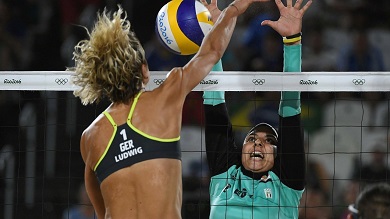
When I first beheld the photo that has gone viral around the world of the women’s beach volleyball match between Egypt and Germany – specifically the meeting at the net of Egyptian player Doaa Elghobashy and German counterpart Kira Walkenhorst – I marvelled for the simple reason that it seemed to say something about the cultural differences between Islam and Western society generally.
What that might be was, of course, up for discussion. Was it just that here – exhibited in stark contrast – was the personification of the freedom to wear whatever one liked and/or was practical in undertaking a sporting activity (i.e. one competitor in a burkini and the other in a bikini)?
Simultaneously, or alongside, inevitably, was the extreme difference in attire – on the one player, a body almost completely covered by fabric; on the other, what might be described as three little triangles covering just the most obvious elements of a naked female body.
Frankly – and you can call me a leather-skinned old bat if you wish – the one aspect that never occurred to me was the one that has struck Hannah Smith, i.e. that both outfits were symptoms of the tired old fact of life that, whatever a woman wears to play sport, she’ll always be judged by the men watching.
Hold that thought for a moment.
Next to Lindy West’s dissection of the supposed sexist manner in which female participation in the Olympics is covered and analysed by the world’s broadcasters.
I actually think this is quite an interesting and thought-provoking piece, but where I take issue with her is her guide as to how to cover women’s sport and/or things to avoid when doing so.
I’m referring to her ‘Dos’ and ‘Don’ts’ – viz. don’t discuss female participants’ looks, make-up, size, hair-do, or appearance generally … don’t refer to their ‘other halves’ … do be careful about references to their attractiveness (or perhaps indeed their lack of it, as in by not referring to their looks when comparing them with other ‘more attractive’ competitors.
Try to hold that thought as well for a moment.
 Lastly, to Radhika Sanghani’s review of the most sexist moments of the Olympics coverage so far.
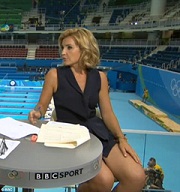
To be fair, there have apparently been a number of them (I have not seen any myself, but I’ve noticed references to two or three on social media) and in particular I want to mention the episode two or three nights ago at the swimming meet, when poolside BBC presenter Heather Skelton wore a little black number showing a fair bit of thigh that suddenly sent the Twittersphere wild with accusations of inappropriateness … and then counter-claims of “Woman has legs – get over it!” defending Skelton and her choice.
All these bring me to my point today.
For me, all three of these articles highlight certain things about female participation in sport and indeed female sports-viewing habits.
I don’t want to go down the ‘health improvement’ trail in commenting upon them because I take it as read that a ‘healthy’ diet – and just as important – a healthy lifestyle (which includes regular exercise-taking) are to be encouraged in terms of the nation’s health generally for both sexes – but particularly for women because historically they are less inclined to play sport (or engage in aerobic activity for the sake of it) than men.
However. The fact is that, by an overwhelming margin, most ardent sports-watchers are men.
Furthermore – left to their own devices, unless perhaps they have a family relative or a friend actually taking part – (and please let me go large in my generalisations!) most men would rather watch men’s sport than women’s. Partly because the latter is less dynamic, less physical and less competent than men’s. Which, frankly, it is – unless someone is going down the route of admiring female performances as being ‘good for a girl’ in comparison to a man’s equivalent.
Therefore (and the survival of the human race will depend upon it, well unless and until they discover a method of producing sperm in a test tube and thereby make the male of the species totally redundant) men’s willingness to watch women’s sport will always be dictated to an extent by reference to the participants’ attractiveness, or their retained femininity in the context of an event in which success ordinarily rewards aggressiveness and other ostensibly non-feminine attributes … or even (let’s not skirt the issue) just the skimpiness, or otherwise, of their outfits etc.
My final comment today is not an attack on the sisterhood, but rather an acceptance of life as it actually is.
When I briefly worked in the television industry many moons ago, it was a well-known phenomenon in the ‘viewer relations’ departments of every UK broadcaster that the overwhelming proportion of comments received from members of the public about female news and other presenters – whether these were ageist, sexist, about their choice of outfit, or otherwise – came from women.
Men may have their brains located in their groin – and indeed may look at females generally in a mildly-to-worse sexist fashion, well unless heterosexuality is not their thing perhaps – but without doubt women have a far deeper interest in wider aspects of individuals than just (in a sporting context) their sporting performances.
 They like to know the competitors’ back stories, their family set-ups, whom they might be dating, their degree of celebrity and yes, they’re no strangers to sexism either – whether any given competitor be a ‘fit’ looking man, or indeed an attractive (or not) female who has unwittingly perhaps made some fashion blunder or indeed looks particularly stunning on the day in question.
This is one of the eternal dilemmas when we contemplate women and sport, especially of the elite variety.
We want women to be taken seriously as sporting stars, not least because they can be role models and help to promote healthy lifestyles and sports-participation generally. But women’s sport is not the same as men’s – and it never will be.
Yet equally, as women, we’re just as interested (if not more so than men) in how female sports stars look and what they wear when participating.
We cannot help ourselves – we criticise female competitors who are maybe a little on the tubby side when their sportswear is somehow revealing or unflattering. We love it when a losing female competitor becomes emotional – rather than remaining stone-faced – when she loses out on a medal place in her event.
Sport these days at elite level is of generally higher quality than it has ever been. However, in female sport, greater athleticism and fitness brings more power and greater premium inevitably being placed upon (what might be termed) male-like attributes. Which some – including male sports fans – might argue tends to detract what makes female sport attractive in the first place.
Who wants to watch a bunch of butch quasi-male-shaped women winning Olympic medals, or indeed anything else?
Bring back great female sports stars who were feminine through and through (like Evonne Goolagong and Maria Bueno) I say!
