
When common sense goes AWOL
Yes, I am a male correspondent in his late sixties and therefore – despite any pretensions to being sympathetic to the cause of female emancipation I may claim from time to time – no doubt have the fairly rudimentary attitude towards feminism and women generally that as man of my generation would, or so the sisterhood might have it.
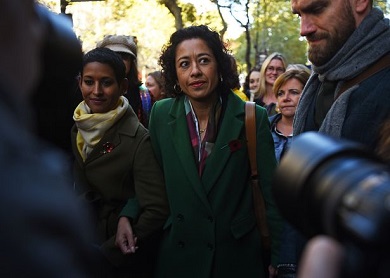
Nevertheless, when I came across the media reports of the Samira Ahmed employment tribunal case against the BBC overnight, I became somewhat exasperated.
See here for a representative example, penned by Sam Waterson, media editor, as appears on the website of – THE GUARDIAN
 For me, it demonstrates both the loony attitudes of 21st Century ‘right on’, equality for all, ‘woke’-ful, activism and also the fundamental weaknesses inherent in an organisation such as the BBC which – in attempting to be all things to men (and women) – gets itself into situations that effectively paralyse its attempts to be at one and the same time supposedly a player in the world of capitalism and a ‘responsible’ organ of the Establishment attempting to bend to whatever the social mores of the time demand.
Let me state the bleedin’ obvious. The BBC cannot win because it is constantly trying to square a circle that cannot be squared (or should that be ‘circled’? I’m confusing even myself now).
 The way the world of business operates is that you buy stuff from one person and sell it to another, if possible for more money than you bought it.
That’s how you hopefully firstly, take care of all the costs of your business activities and then secondly, generate enough money left over to both keep your business going (including allowing you to invest in the future, promote your wares to the customer and advance the cause of everyone involved in your organisation) and have some cash left over to pay yourself (and okay, also perhaps make you a healthy profit on top).
 Somewhere in there the capitalist principle that you only get paid what you can persuade someone to pay you kicks in.
Say you and a competitor are in the business of making widgets, if you can make yours better, or more durable, or even simply more popular because your branding and marketing are superior, you’ll do better and make more money than your competitor.
As indeed you will if you hire superior and more productive staff (and keep them happy and motivated) – and indeed as you will if you’re simply better at running a business than the other guy (or gal).
Stands to reason, don’t it?
 The same principle applies when you’re an employee.
There’s no rule in Life that says he (or she) who is a better worker than everyone else will also get paid more than everyone else. It might be a good thing if that were the case, of course, but life isn’t like that.
Whether a good worker gets paid more than another, less-good (or less efficient, dynamic, intelligent, or socially adept and personable) worker might depend upon the vagaries of where in the country they live and work, whether they’ve ended up in a go-ahead company or a tired, old-fashioned one that hasn’t moved with the times … and indeed what sort of person the business owner is.
 Which brings me back to Samira Ahmed and her beef with the BBC.
In the cause of equality between the sexes, Ahmed is essentially making the case that if a woman is doing the same job as a man then she should be paid similar. On the face of it, nothing wrong with the logic and reasoning.
But – and in adding here that I’m not seeking to make a political point, it may be that I am – there’s a clash of fundamentals between the socialist/communistic thrust that everyone should be paid the similar for similar work and the capitalist equivalent that excellence or superiority should be recognised by greater reward.
Say two workers are making widgets.
 At best Worker A produces them at the rate of 10 per hour, whilst Worker B can turn out 20. Classic business theory pays by results so on the face of it Worker B should be paid twice as much – however, classic ‘equality for all’ theory would describe that as unfair.
It might even go further and maintain that if Worker A can only produce 10 widget per hour, then nobody should be allowed to produce more.
And never the two theories meet or satisfy. Worker B might get bored and demotivated if they are only allowed to produce 10 widgets per hour. Productivity goes down and therefore so will turnover and then profit (if any).
 And this applies to more than productivity.
If Worker B is more attractive, or more experienced, or even simply (e.g. if one is taking about sales personnel) has ‘the knack’ of making more sales, or those that generate more revenue – even if they work less hard than Worker A – then they’re going to be more valuable to the business.
And thus we return to the principle that an employee is only ever worth what they can persuade someone to pay them.
In Samira Ahmed’s case, yes (on the face of it) if a woman and a man ‘are doing the same presenting job in television’ there’s no reason why they shouldn’t be paid similar wages.
 But that doesn’t take into account outcome and results.
You might as well argue that because a female footballer is a centre forward/striker she should therefore automatically be paid as much as Christiano Ronaldo, Sergio Agüero or Jamie Vardy.
 Or that any female boxer should be paid the same as Tyson Fury.
 Or – dare I say it? …
That any bright young male model strutting his stuff on a Paris catwalk should be paid the same as Cara Delevingne.
My point is that Samira Ahmed is claiming that because she presents a certain BBC programme – and that Jeremy Vine presents another, similar-length, similar-type BBC programme – they should be paid the same amount.
 My first instinctive reactions to learning that Jeremy Vine is going to be at the helm of a television programme is that I’m going to get quality, professionalism and “Oh, so that’s what Jeremy’s doing next …”
When I learn that Samira Ahmed is going to be presenting a programme, my first reaction is “Who she?”
That’s not going to stop me watching said broadcast, I may do so and enjoy it very much. But the fact that Ms Ahmed is going to present it will not make the slightest difference to whether I choose to watch it.
Whereas the fact that Jeremy Vine is presenting might.
That’s all. And in my submission, that’s justification enough for Vine to get paid more than Ahmed.
(And it doesn’t surprise me at all that the BBC finds itself embroiled in this employment tribunal pickle. It spends so much of its time trying to virtue-signal that, whenever some activist or another demands “Jump!”, its first and only reaction is “How high would you like?”).
